In this article
- 1. Start With the Bedroom’s Existing Traffic Path
- 2. Choose a Desk That Fits the Room, Not Just the Wall
- 3. Use a Floating Desk When Floor Space Is Precious
- 4. Turn an Awkward Corner Into a Workspace
- 5. Keep the Workspace Away From the Bed When You Can
- 6. Let One Piece of Furniture Do Two Jobs
- 7. Use a Chair That Doesn’t Visually Take Over
- 8. Use Vertical Space Instead of More Floor Furniture
- 9. Keep the Desk Surface Intentionally Small
- 10. Give Office Supplies a Home Outside the Desk
- 11. Control Cables Before They Become Bedroom Clutter
- 12. Use Lighting That Can Shift From Work to Wind-Down
- 13. Make the Work Zone Visually Belong to the Bedroom
- 14. Try a Fold-Down Workspace When You Need the Floor Back
- 15. Create a Simple End-of-Day Reset
- 16. Keep the Bedroom From Becoming “All Office”
- 17. Make the Workspace Easy to Remove or Adapt
- 1. Map the room
- 2. Decide what you actually need for work
- 3. Choose the desk footprint
- 4. Choose the chair
- 5. Solve storage
- 6. Solve lighting
- 7. Control cables
- 8. Create an end-of-day reset
- Buying a desk before considering the whole room
- Choosing a desk based only on width
- Blocking the main walking path
- Adding too much office storage
- Ignoring cable management
- Relying on one harsh light
- Leaving work equipment permanently spread across the bedroom
17 Small Bedroom Ideas for a Bedroom That Doubles as a Home Office
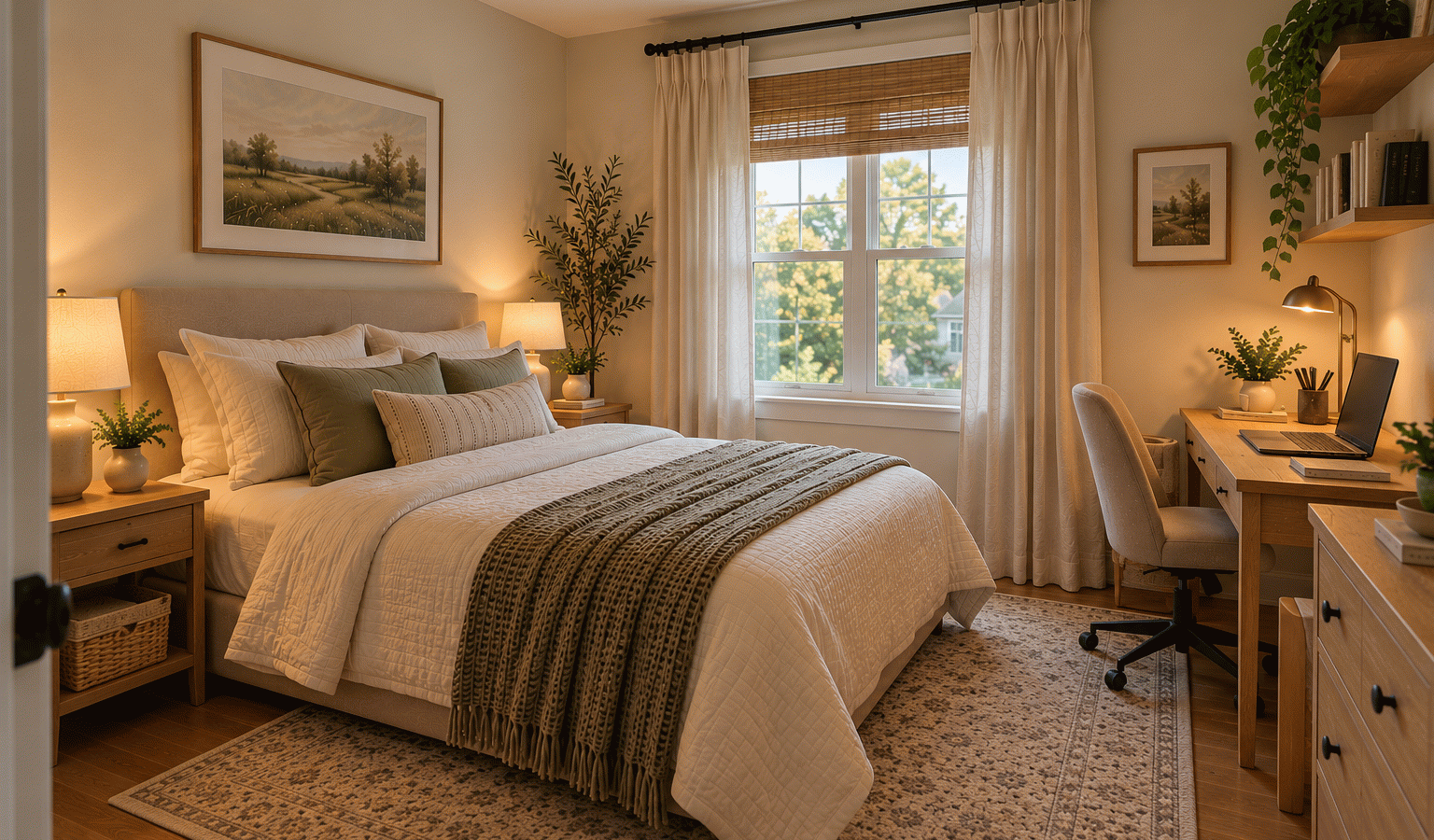
Working from a small bedroom can be surprisingly tricky. A desk may fit along one wall, but that doesn’t necessarily mean the room will still feel comfortable once you add a chair, computer, cables, storage, and everything else you use during the day.
The goal is to create a workspace without making the bedroom feel like a permanent office.
The best setups usually start with the room itself: how people move through it, what furniture is already there, how much work surface is actually needed, and what can be put away when the workday ends. These small bedroom home office ideas focus on making those decisions easier while keeping the room practical and comfortable.
1. Start With the Bedroom’s Existing Traffic Path
Before buying a desk, pay attention to how you already move through the bedroom.
Look at the path from the door to the bed, closet, dresser, and window. A desk that technically fits may still create an awkward bottleneck if the chair sits directly in a walkway.
Try sketching the room roughly or simply standing in different spots and imagining where the chair will be when you’re working. The workspace should fit into the room’s existing rhythm rather than forcing everything else around it.
If you’re still figuring out where the bedroom’s furniture should go, our guide to small bedroom layout ideas can help you think through the larger arrangement first.
2. Choose a Desk That Fits the Room, Not Just the Wall
A desk needs more than enough wall space to fit its width.
You also need room for the chair, enough surface for the work you actually do, and enough clearance to move around it comfortably.
For example, someone who mainly uses a laptop may need a very different workspace from someone who regularly works with a monitor, notebook, keyboard, and other equipment.
Before buying anything, measure the available area and then think about the desk as a three-dimensional piece of furniture—not just a rectangle against the wall.
A compact desk with a relatively shallow footprint can be a useful option when floor space is limited, especially if your work doesn’t require a large surface.
3. Use a Floating Desk When Floor Space Is Precious
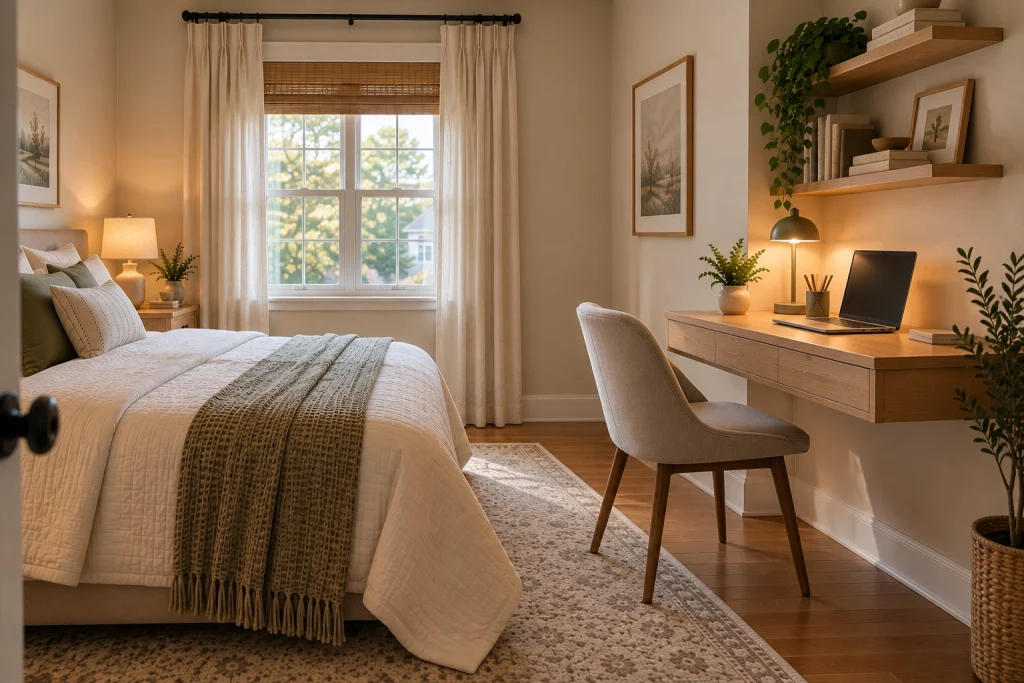
A floating desk can be useful when you want a dedicated work surface without adding another bulky piece of furniture to the floor.
Because the workspace attaches to the wall, the area underneath can remain visually lighter and may be easier to clean or use for a small stool, basket, or other purpose.
This approach works particularly well in bedrooms where there is an otherwise unused stretch of wall.
If you’re renting, however, check what kinds of wall installation your lease allows before choosing a permanently mounted option.
4. Turn an Awkward Corner Into a Workspace
Not every bedroom has a convenient long wall for a traditional desk.
An unused corner can sometimes become a practical workspace with a narrow desk or appropriately sized corner surface.
The important part is to work with the shape of the room. A corner that looks empty may become difficult to use once you account for the chair, drawers, doors, or nearby furniture.
Keep the setup simple. A small desk, laptop, lamp, and one useful storage solution may be enough.
5. Keep the Workspace Away From the Bed When You Can
If there’s a choice, avoid making your desk feel like an extension of the bed area.
You don’t necessarily need a room divider. Even a little visual separation can help: place the desk on another wall, use a different orientation, or create a subtle boundary with a rug, artwork, or furniture placement.
The idea is simply to give the two functions their own identity.
When you’re working, the desk feels like a workspace. When you’re resting, the bed remains the visual focus.
That distinction can make a small multifunctional bedroom feel more intentional.
6. Let One Piece of Furniture Do Two Jobs
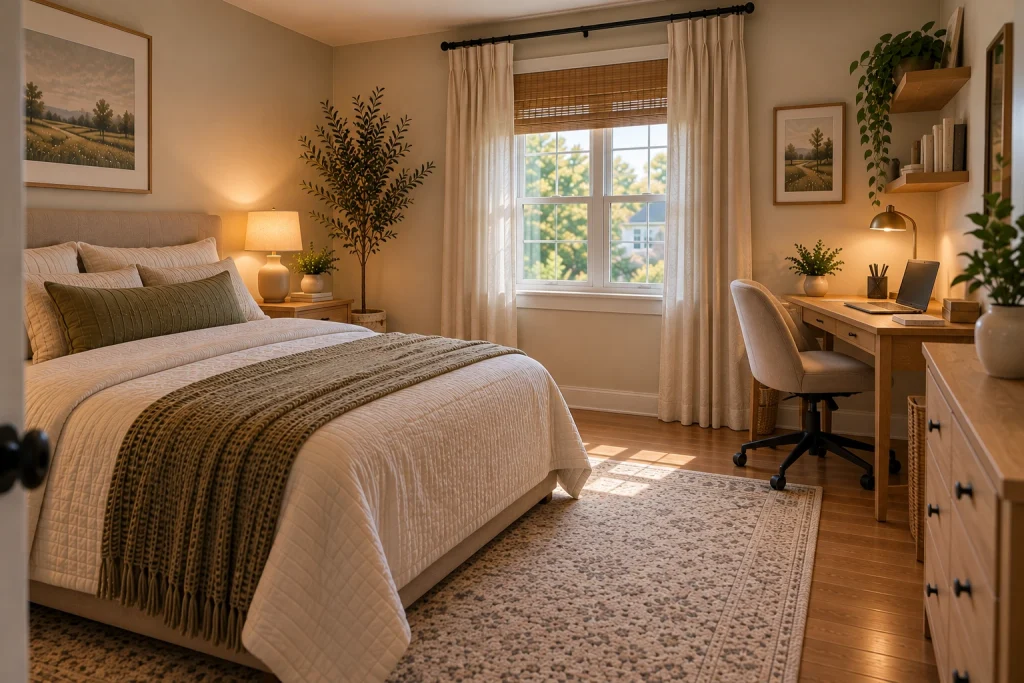
When floor space is limited, furniture that can serve more than one purpose can be useful.
A slim desk might also work as a vanity. A console-height surface might serve as a workspace while looking like part of the bedroom furniture. A small cabinet might provide both storage and a work surface.
The key is not to force every piece of furniture to have multiple jobs. Choose combinations that actually make sense for how you use the room.
A piece that performs two useful functions is valuable. A piece that does two jobs badly simply creates another compromise.
7. Use a Chair That Doesn’t Visually Take Over
A large office chair can become one of the most noticeable objects in a small bedroom.
If your work setup allows it, look for a chair with proportions that suit the room and that can tuck fully underneath the desk when you’re finished.
A chair that can easily move to another part of the room can also be useful.
But don’t sacrifice basic comfort simply because the chair looks smaller. If you work at the desk for several hours, the chair still needs to suit the way you actually sit and work.
8. Use Vertical Space Instead of More Floor Furniture
When floor space is already limited, look upward.
A small shelf, wall organizer, pegboard, or other vertical storage solution can hold items that would otherwise end up on the desk.
This is especially useful for things you reach for regularly but don’t need directly in front of you all day.
The goal isn’t to cover the wall with storage. A small amount of well-chosen vertical organization can be enough to keep the work surface clear.
For more ways to organize belongings in a compact bedroom, see our guide to small bedroom organization ideas.
9. Keep the Desk Surface Intentionally Small
A bigger desk isn’t automatically a better workspace.
If you mainly work from a laptop, a huge desktop may simply become a place where papers, chargers, cups, and miscellaneous items collect.
Instead, think about what actually needs to stay within reach.
Keep the surface large enough for your normal work but small enough that it doesn’t encourage unnecessary clutter. If your work changes from day to day, a little flexibility is useful—but you don’t need to dedicate half the bedroom to a desktop you rarely use.
10. Give Office Supplies a Home Outside the Desk
A small bedroom office becomes difficult to maintain when every work item has to live on the desktop.
Think about where your notebooks, headphones, chargers, documents, stationery, and other supplies will go when you’re not using them.
A drawer, small cabinet, storage box, or shelf can give these things a defined home.
This matters even more when your bedroom serves another purpose after work. If everything has somewhere to return to, clearing the workspace takes minutes instead of becoming another project.
11. Control Cables Before They Become Bedroom Clutter
Cables are easy to ignore when setting up a workspace, but they’re one of the quickest ways for a small desk to look messy.
Think about cable routing before you plug everything in.
Simple solutions can include:
- clips that keep charging cables near the edge of the desk
- routing cables underneath the desktop
- keeping the power strip in one accessible location
- using one dedicated charging area
- avoiding unnecessarily long cables
You don’t need an elaborate cable-management system. The goal is simply to prevent a small workspace from becoming a tangle of cords.
If you buy cable-management products, choose them based on the equipment you actually use rather than adding accessories just because they look organized online.
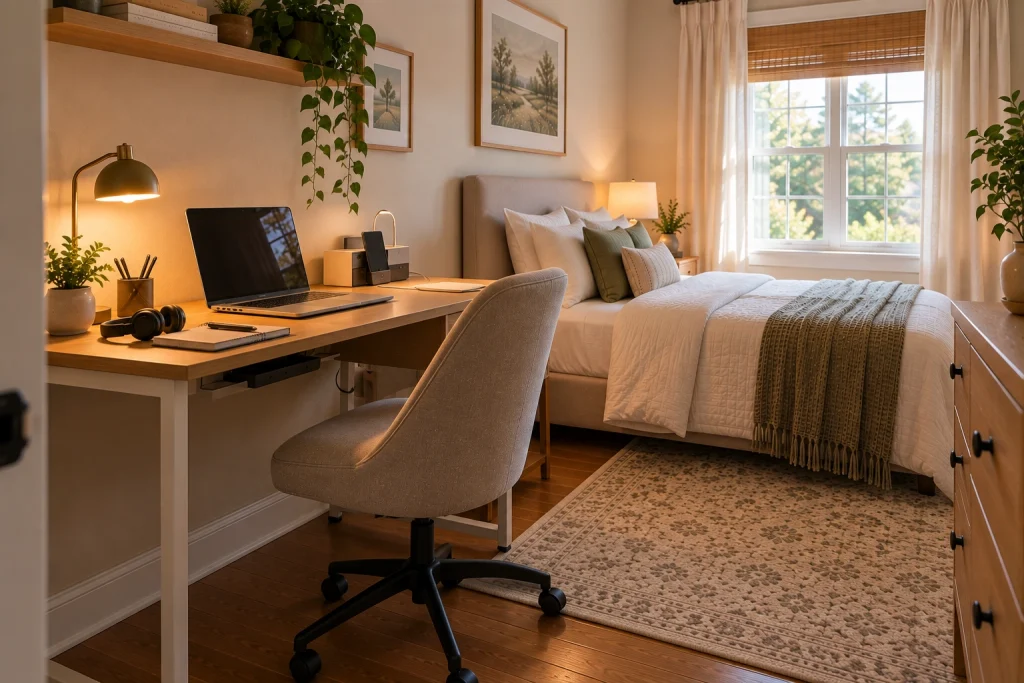
12. Use Lighting That Can Shift From Work to Wind-Down
A bedroom office needs useful light during working hours, but the room shouldn’t have to stay brightly lit when you’re ready to relax.
A focused desk or task light can provide more direct illumination while you’re working. Later, you can rely more on the bedroom’s softer ambient and bedside lighting.
This is one reason layered lighting works particularly well in a bedroom that has two functions.
Our guide to small bedroom lighting ideas goes deeper into using multiple light sources without taking up unnecessary space.
13. Make the Work Zone Visually Belong to the Bedroom
A desk doesn’t have to look like it came from a completely different room.
Choose finishes and colors that already exist elsewhere in the bedroom. A light wood desk can work naturally with an oak bed frame. A neutral chair can disappear more easily into a soft, neutral bedroom palette.
You can also use one or two small decorative elements—such as artwork, a plant, or a simple desk accessory—to connect the workspace with the rest of the room.
The goal isn’t to decorate the desk heavily. It’s to make the workspace feel like part of the bedroom rather than an office that happens to be inside it.
For more ideas on finishing a small bedroom without overcrowding it, see our small bedroom decor ideas.
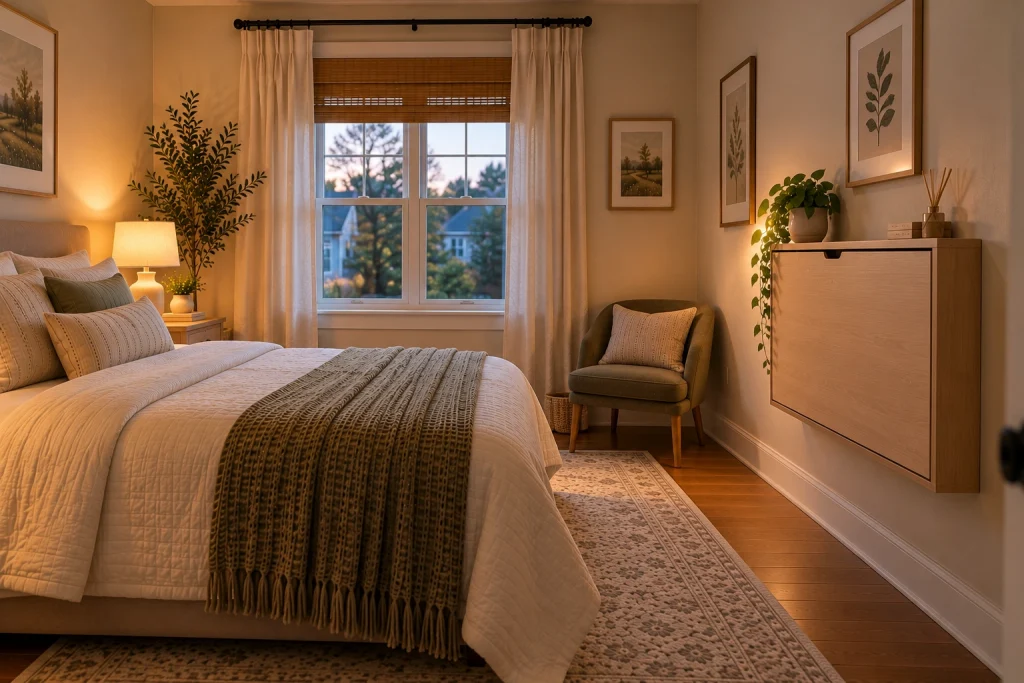
14. Try a Fold-Down Workspace When You Need the Floor Back
If you only need a workspace for part of the day, a fold-down desk can be an interesting solution.
When open, it provides a dedicated surface for a laptop or other essentials. When closed, it can reduce the visual presence of the office area.
This can be particularly useful in very compact bedrooms where a permanent desk would take up valuable floor space.
The important thing is to think about what you’ll need to put away when the desk closes. A fold-down workspace works best when your everyday setup can be packed away without a complicated routine.
15. Create a Simple End-of-Day Reset
One of the easiest ways to stop a bedroom office from taking over the room is to create a short closing routine.
It doesn’t have to be complicated.
- Close the laptop.
- Put away chargers and small accessories.
- Return the chair to its normal position.
- Clear anything that doesn’t belong on the desk.
- Switch from work lighting to your normal bedroom lighting.
The whole process can be simple enough that you actually do it every day.
The important part is creating a clear point where the workspace stops being the center of the room.
16. Keep the Bedroom From Becoming “All Office”
It’s easy to keep adding things once you’ve created a workspace.
Maybe you need another shelf. Then another storage box. Then a larger monitor. Then another piece of office furniture.
Before long, the bedroom can start looking more like an office with a bed in it.
Be selective.
If your work setup only needs a laptop, small desk, comfortable chair, and a few accessories, there may be little reason to add a large filing cabinet or several shelves.
Remember what the room is primarily for. The workspace should support the bedroom, not completely take it over.
17. Make the Workspace Easy to Remove or Adapt
A flexible workspace can be more useful than one designed around a single perfect setup.
Your work requirements might change. You may start using a monitor, stop using one, work fewer hours from home, or eventually move the workspace to another room.
Choose furniture and storage that can adapt when possible.
That might mean a desk that can later become a console, a chair that can move elsewhere, or storage that can be used for bedroom items if your work setup changes.
In a small room, flexibility has real value because every piece of furniture has to earn its space.
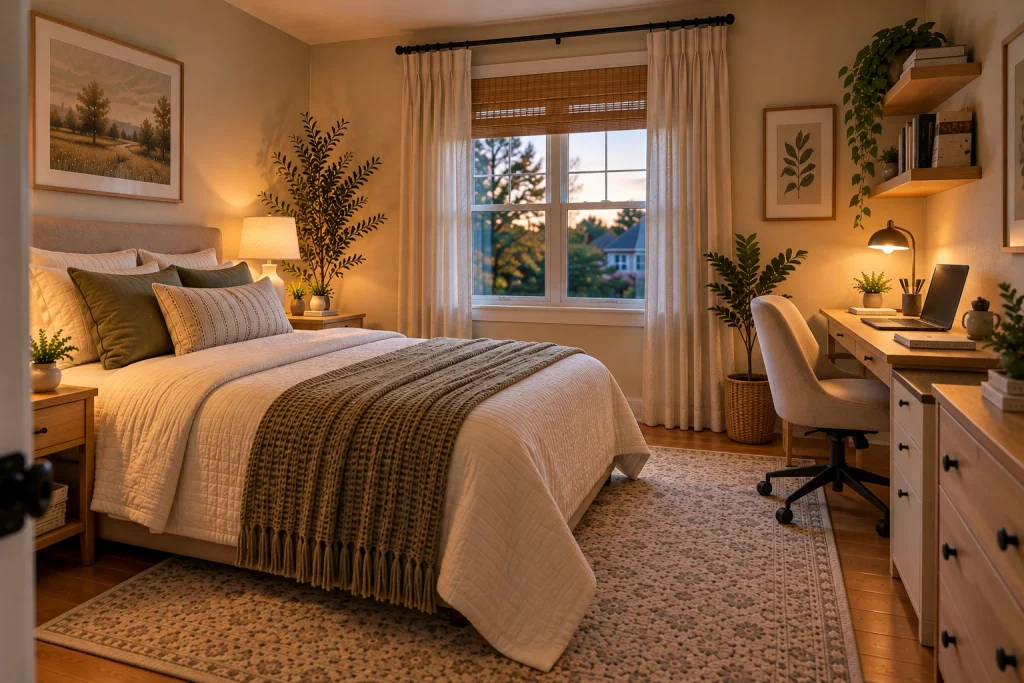
How to Put Together a Small Bedroom Home Office
You don’t need to buy everything at once. Start with the room and build the workspace around your actual routine.
1. Map the room
Identify the bed, closet, door, windows, existing furniture, and main walking paths.
2. Decide what you actually need for work
Think about whether you work primarily from a laptop or regularly use a monitor, keyboard, notebooks, or other equipment.
3. Choose the desk footprint
Once you know what you need, choose the smallest practical desk that supports it comfortably.
4. Choose the chair
Make sure the chair works with the desk and can be tucked away or moved when you’re finished.
5. Solve storage
Decide where work supplies will live when they’re not being used. Don’t automatically add more furniture if a shelf or existing drawer can handle the job.
6. Solve lighting
Use focused light for work and softer lighting when the bedroom returns to its normal evening role.
7. Control cables
Route the cables before the workspace becomes cluttered. A few simple clips and a sensible charging location can make a noticeable difference.
8. Create an end-of-day reset
Make it easy to close the laptop, clear the surface, put away accessories, and return the room to bedroom mode.
Small Bedroom Home Office Mistakes to Avoid
Buying a desk before considering the whole room
A desk can fit against a wall and still interfere with the closet, doorway, or walking path.
Choosing a desk based only on width
Depth matters too. So does the space needed for the chair.
Blocking the main walking path
A workspace shouldn’t make basic movement around the bedroom frustrating.
Adding too much office storage
More storage isn’t always better. Start with what you actually need to keep nearby.
Ignoring cable management
A compact workspace can quickly look cluttered when several cables are left hanging across the desk and floor.
Relying on one harsh light
A bedroom used for both work and rest benefits from lighting that can change with the activity.
Leaving work equipment permanently spread across the bedroom
If the desk never gets cleared, the room can gradually stop feeling like a bedroom. Give yourself an easy way to reset the workspace.
Final Thoughts
A small bedroom doesn’t need a large office area to support working from home.
The more useful approach is to look at the room as a whole and decide what the workspace actually needs. A compact desk, a chair that fits, sensible storage, controlled cables, and flexible lighting may be enough.
Just as importantly, think about what happens after work.
When the laptop closes and the desk can be cleared without much effort, the room can return to being a bedroom. That flexibility is what makes a small bedroom home office feel practical rather than crowded.