In this article
- 1. Start by Defining What Your Closet Actually Needs to Hold
- 2. Give the Closet Replacement One Defined Home
- 3. Choose a Slim Wardrobe When a Full-Depth One Would Crowd the Room
- 4. Use Sliding Doors When the Wardrobe Is Close to Other Furniture
- 5. Make One Piece of Furniture Handle More Than One Clothing Function
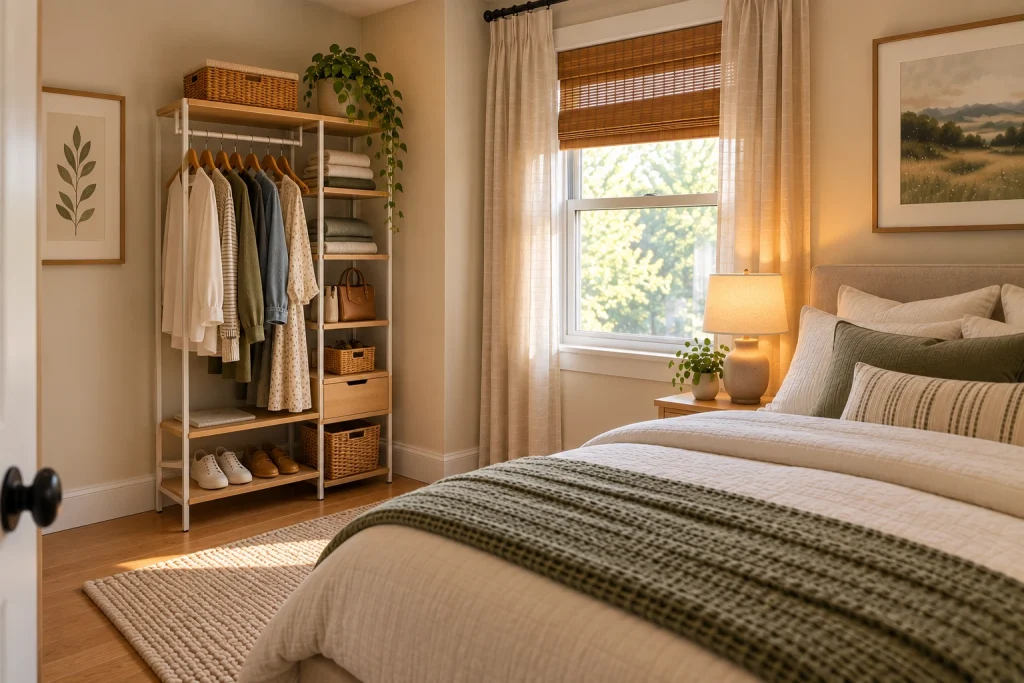
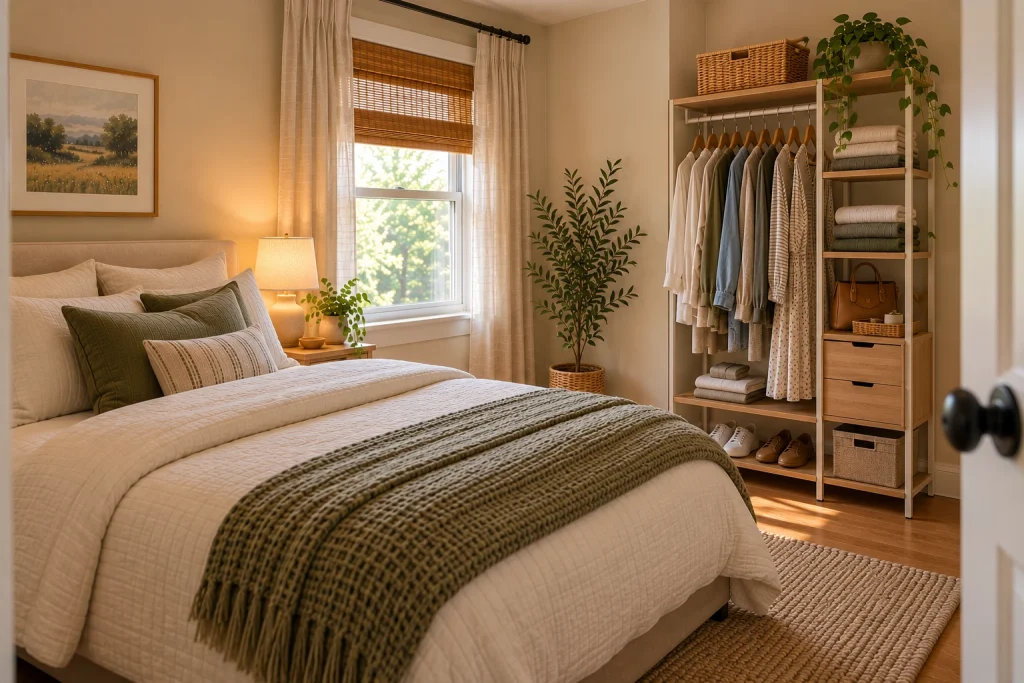
- 6. Use a Compact Garment Rack If Your Hanging Needs Are Limited
- 7. Keep an Open Wardrobe Visually Controlled
- 8. Add a Curtain When You Want an Open Closet Without the Visual Clutter
- 9. Put Everyday Clothes in the Prime Part of the Clothing Zone
- 10. Don’t Let Seasonal Clothing Take Over the Main Clothing Zone
- 11. Treat Shoes as Part of the Closet Replacement
- 12. Create a Small Extension for Bags and Accessories
- 13. Reserve the Top of the Wardrobe for Things You Rarely Need
- 14. Give Laundry Its Own Destination
- 15. Test the Working Space Before You Commit to the Furniture
- 16. Make the Closet Replacement Look Like It Belongs There
- 17. Build the Complete Closet Replacement Before Adding More Storage
- How to Choose the Right No-Closet Setup
- Choose a wardrobe if:
- Consider a garment rack if:
- Combine both if:
- Common Mistakes to Avoid
- Final Thoughts
17 Small Bedroom Ideas Without a Closet That Actually Work
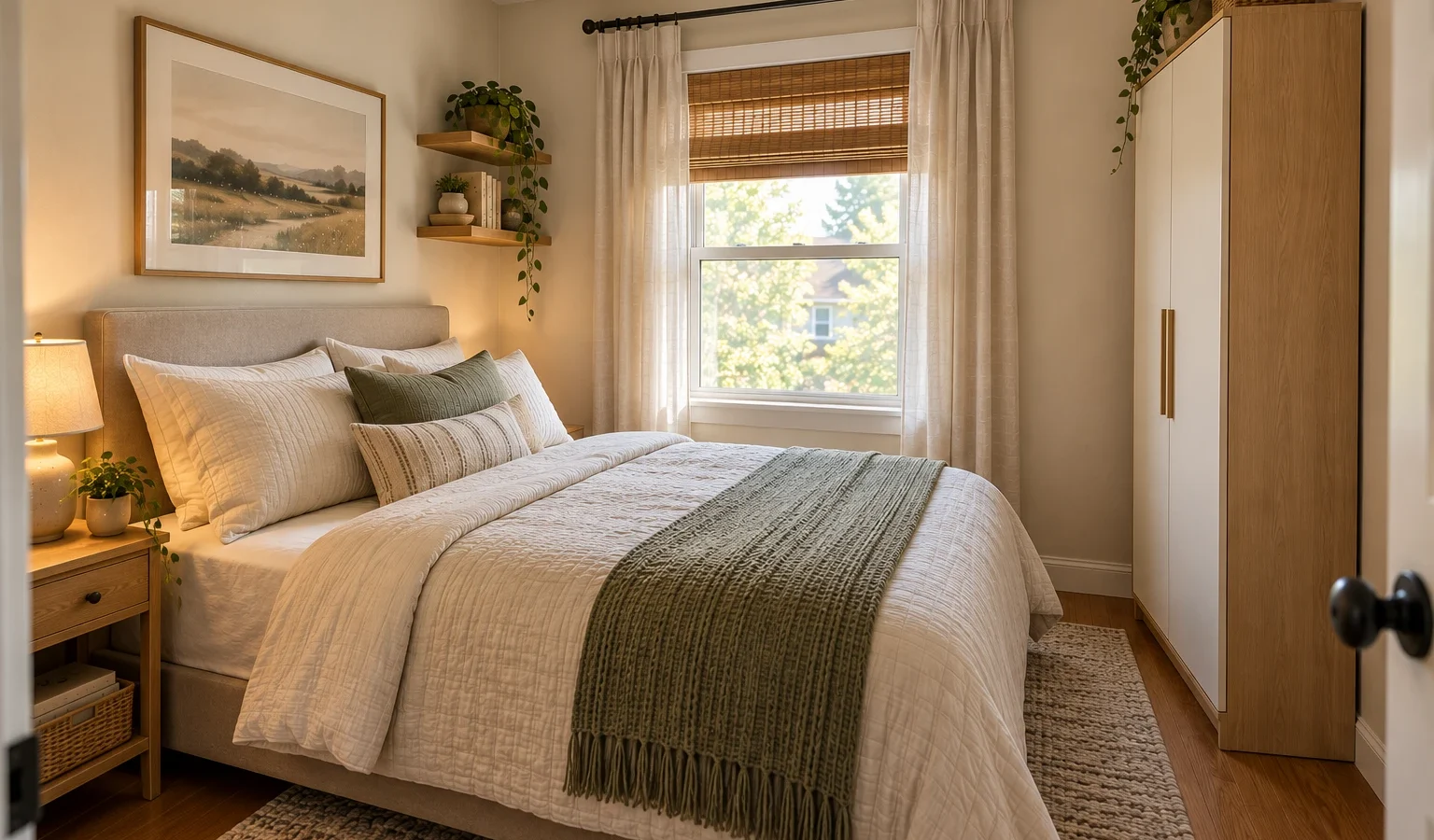
A bedroom without a built-in closet can be surprisingly difficult to organize, especially when the room itself is small. The challenge isn’t simply finding somewhere to put your clothes. You need a practical place for hanging pieces, folded clothing, shoes, accessories, laundry, and less frequently used items—without filling the bedroom with bulky furniture.
The easiest way to approach the problem is to stop thinking about replacing the closet itself and start thinking about replacing what the closet does.
A slim wardrobe might handle hanging clothes. A compact rack could provide additional flexibility. A curtain can visually separate an open clothing zone, while higher storage can take care of items you rarely use.
These small bedroom ideas without a closet focus on building that kind of complete clothing system, so the room stays functional without feeling like a storage room.
1. Start by Defining What Your Closet Actually Needs to Hold
Before choosing any furniture, look at the clothes you actually own.
You may discover that you don’t need a large traditional wardrobe at all. Perhaps most of your clothes are folded, while only a small number of pieces need to hang. Or you may need more hanging space but very little drawer storage.
Separate your clothing into a few practical groups:
- Clothes that need to hang
- Clothes that can be folded
- Shoes and accessories
- Seasonal or occasional items
- Laundry
This gives you a much clearer starting point.
Instead of asking, “What closet should I buy?”, ask, “Which closet functions do I actually need?”
That small change can prevent you from bringing a large piece of furniture into an already tight bedroom.
2. Give the Closet Replacement One Defined Home
One of the biggest problems with a bedroom that has no closet is allowing clothing storage to spread across the entire room.
A wardrobe ends up beside the bed. Shoes collect near the door. Bags land on a chair. Extra clothes get placed wherever there happens to be space.
Instead, create one identifiable clothing zone.
This could be one wall, one corner, or one section of the bedroom where your wardrobe or clothing rack and its supporting storage live together.
The rest of the room can then remain dedicated to sleeping and relaxing.
This is different from simply adding more storage. You’re creating a clear boundary between the bedroom zone and the closet zone.
If you also need general space-saving storage elsewhere in the room, our guide to small bedroom storage ideas covers those solutions separately.
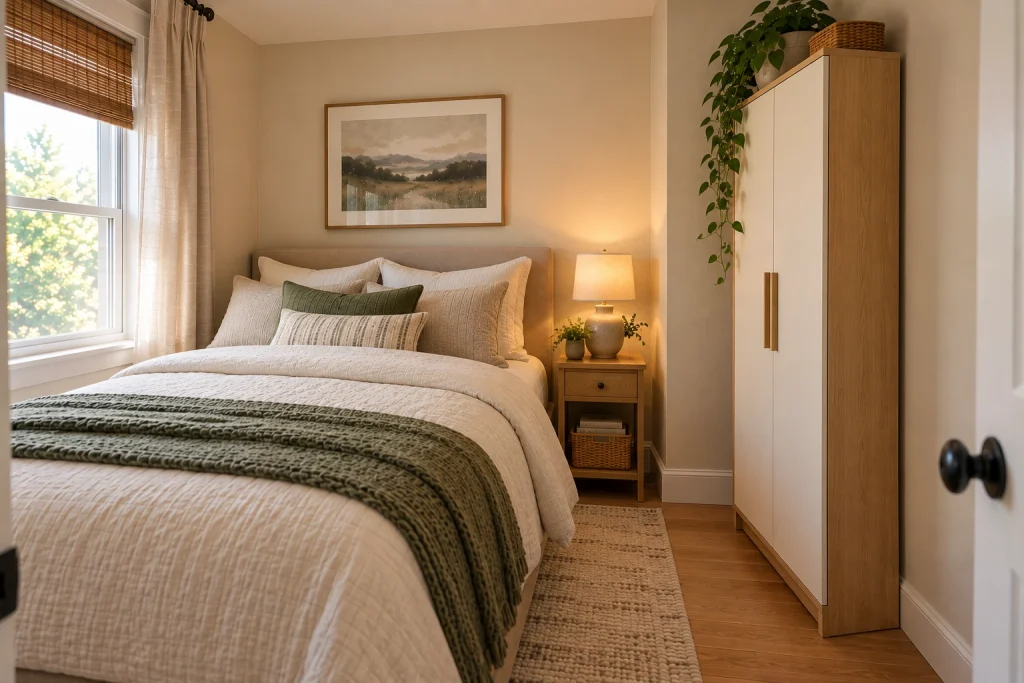
3. Choose a Slim Wardrobe When a Full-Depth One Would Crowd the Room
A wardrobe can replace a closet without taking over the bedroom, but its depth matters just as much as its width.
A large, deep wardrobe may technically fit against a wall while making the rest of the room difficult to use.
A slimmer wardrobe can be a better choice when you only need a modest amount of hanging space.
Look for a configuration that uses its footprint efficiently, such as a combination of hanging space and shelves rather than a large empty hanging compartment.
Before buying, measure the furniture’s actual depth and mark that footprint on the floor if necessary. Then check whether you can still move comfortably around it.
In a small bedroom, a few inches can make the difference between a useful closet substitute and furniture that constantly gets in the way.
4. Use Sliding Doors When the Wardrobe Is Close to Other Furniture
A wardrobe with hinged doors needs additional space every time you open it.
That can become awkward when the wardrobe is close to the bed, a desk, or the main walking route.
Sliding doors eliminate the outward door swing, which can make the front of the wardrobe easier to use in a tight room.
They aren’t automatically the right answer for every bedroom. You still need enough standing space in front of the wardrobe to access your clothes.
But when the main problem is the door competing with nearby furniture, sliding doors can make the same storage footprint considerably easier to live with.
5. Make One Piece of Furniture Handle More Than One Clothing Function
A no-closet bedroom becomes difficult when every clothing category gets its own piece of furniture.
Instead, look for ways to combine functions within the same footprint.
For example, a single wardrobe might contain:
- A hanging rail for dresses, shirts, or jackets
- Shelves for folded clothing
- Drawers for smaller items
- A lower compartment for shoes or baskets
This creates a more complete closet replacement without requiring several separate furniture pieces.
The idea isn’t to maximize storage at any cost. It’s to make one carefully selected piece perform several jobs.
That keeps the clothing zone visually simpler and leaves more of the bedroom available for everyday movement.
6. Use a Compact Garment Rack If Your Hanging Needs Are Limited
A garment rack can be a surprisingly effective closet substitute when you don’t own enough hanging clothes to justify a large wardrobe.
It also gives you a lighter-looking option that can work well in a small bedroom.
Choose a compact rack rather than a wide, commercial-looking unit. Then limit the clothing displayed on it to pieces that genuinely need hanging or that you use regularly.
If you need folded storage as well, pair the rack with one existing dresser or another compact storage component rather than building a collection of separate organizers around it.
The goal is a small dressing zone, not a miniature clothing store.
7. Keep an Open Wardrobe Visually Controlled
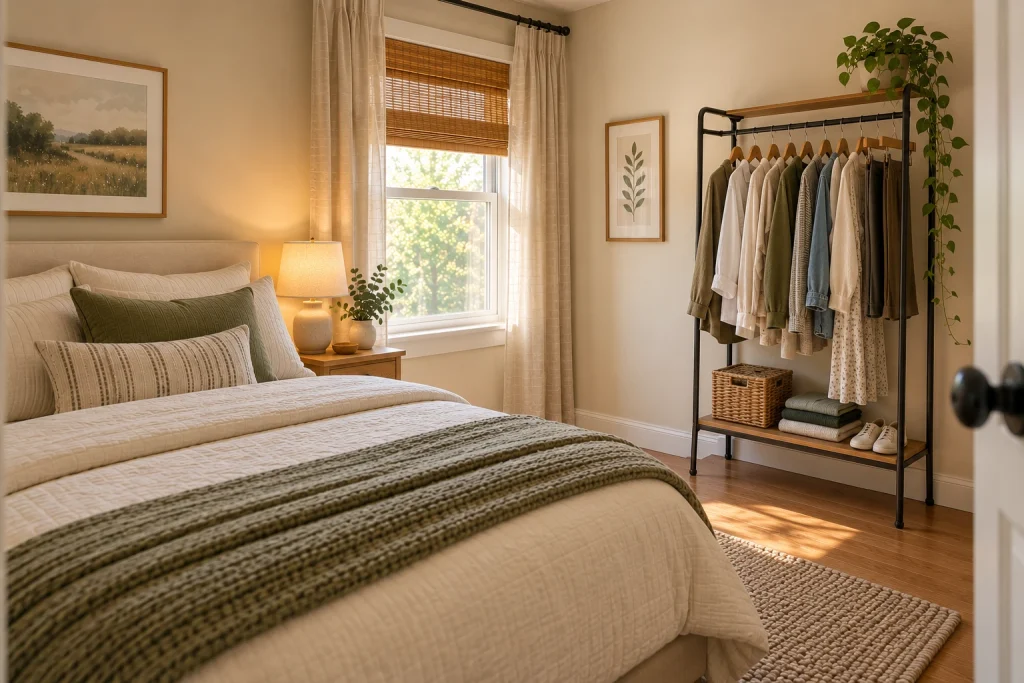
An open wardrobe can work beautifully in a small bedroom, but only when the clothing itself remains visually manageable.
You don’t need every garment packed onto the rail.
Leave a little breathing room between groups of clothing and keep the most frequently worn pieces easiest to reach.
Using similar hangers can also create a more cohesive appearance without requiring additional decoration.
If the rack becomes overloaded, the problem isn’t necessarily the rack itself. It may simply mean that too much of the wardrobe is being kept in the bedroom at once.
An open closet works best when the amount of clothing matches the scale of the storage system.
8. Add a Curtain When You Want an Open Closet Without the Visual Clutter
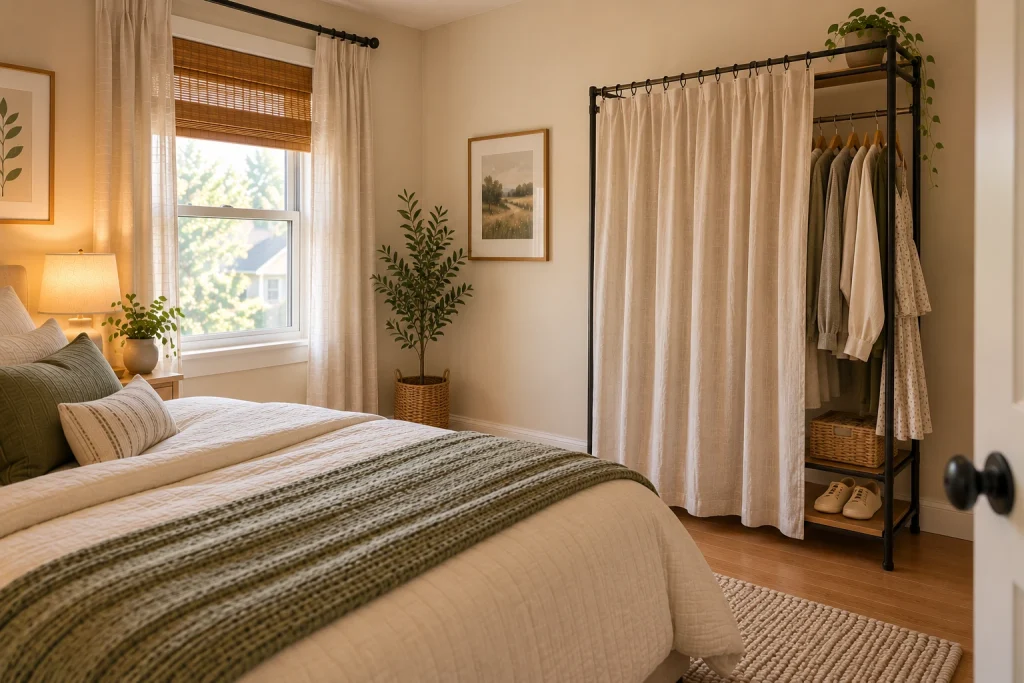
If you like the accessibility of an open wardrobe but don’t want your clothes visible all the time, a curtain can create a simple visual screen.
The curtain can sit in front of a compact hanging zone, allowing you to open it when getting dressed and close it when you want the bedroom to look calmer.
This works particularly well when a traditional wardrobe would feel too bulky.
Choose a fabric and color that relate to the rest of the bedroom so the curtain looks like part of the room rather than an improvised cover.
For renters, it can also be a useful direction when you want a clothing zone that doesn’t require a permanent built-in solution. For more removable bedroom upgrades, see our small bedroom ideas for renters.
9. Put Everyday Clothes in the Prime Part of the Clothing Zone
Not every item needs equal access.
If you wear certain shirts, trousers, or dresses several times a week, those pieces should occupy the easiest-to-reach part of your closet replacement.
Less frequently worn clothing can go higher, farther back, or into a less convenient section.
This creates a simple hierarchy inside a small clothing system:
most used → easiest access
occasionally used → secondary access
rarely used → least accessible storage
That hierarchy is especially useful when your replacement closet is smaller than a traditional built-in closet.
Instead of fighting limited space, you’re reserving the best space for the clothes that actually matter to your daily routine.
10. Don’t Let Seasonal Clothing Take Over the Main Clothing Zone
If your bedroom is small, keeping every seasonal item within arm’s reach can make the closet replacement unnecessarily large.
Heavy winter layers, occasional formal clothing, or other low-frequency pieces can be stored elsewhere when they aren’t needed.
The exact solution depends on your home. A different room, high storage area, or another appropriate storage location may work better than forcing everything into the bedroom.
The important idea is to keep the primary clothing zone focused on current use.
That gives your everyday wardrobe more breathing room and reduces the temptation to buy a larger wardrobe simply because seasonal items are taking up valuable space.
11. Treat Shoes as Part of the Closet Replacement
When there is no closet, shoes often become disconnected from the clothing system.
They end up beside the bed, near the bedroom door, or underneath unrelated furniture.
Instead, give your everyday shoes a defined location immediately beside or within the closet zone.
You don’t necessarily need a dedicated shoe cabinet. A lower section of the wardrobe or a compact shelf may be enough if you only keep a limited number of pairs in the bedroom.
The important part is that the shoes have a known destination.
That keeps them connected to the dressing routine rather than allowing them to become random floor clutter.
12. Create a Small Extension for Bags and Accessories
Your closet replacement doesn’t have to stop at clothing.
Bags, belts, scarves, hats, and other accessories are part of getting dressed, so they should have a defined relationship with the clothing zone.
Keep the pieces you use most often close to the clothes they accompany.
For example, an everyday bag can stay within easy reach of the wardrobe, while occasional accessories can occupy a less accessible section.
The aim isn’t to create another elaborate organization system. It’s simply to prevent accessories from gradually spreading across the bedroom.
A successful closet replacement should make the whole getting-dressed routine easier, not just store shirts and trousers.
13. Reserve the Top of the Wardrobe for Things You Rarely Need
The area above a wardrobe can be useful, but it should have a specific purpose.
Use it for things that don’t need everyday access—such as seasonal accessories, spare bedding, luggage, or other occasional items.
Keep these belongings contained in a few coordinated boxes or baskets rather than leaving loose items stacked on top.
Because the space is less convenient to reach, it naturally works best for low-frequency belongings.
This creates a useful vertical hierarchy without turning the top of the wardrobe into another everyday storage area.
14. Give Laundry Its Own Destination
A closet replacement works much better when clean clothing and laundry have separate destinations.
Without a defined laundry spot, worn clothes can end up on the bed, a chair, or the floor before eventually getting mixed back into the clothing zone.
A compact hamper near the wardrobe can solve this simple but important problem.
It doesn’t need to be large or elaborate. It just needs to be convenient enough that you will actually use it.
Keeping laundry separate protects the main clothing zone from becoming a mixture of clean, worn, and undecided clothes.
15. Test the Working Space Before You Commit to the Furniture
The footprint of the wardrobe isn’t the only space you need to consider.
You also need room to:
- Stand in front of it
- Open or slide the doors
- Reach the back of the storage area
- Move past it
- Carry clothes in and out
This is why a wardrobe that technically fits on a wall can still be the wrong choice.
Before committing, mark the proposed furniture footprint with painter’s tape or temporarily position boxes to approximate its size.
Then walk through the room normally.
Open the imaginary wardrobe doors. Stand where you’d get dressed. Walk from the bed toward the door.
If those movements feel awkward now, they’ll probably feel awkward after the furniture arrives.
For broader furniture-placement considerations, our guide to small bedroom layout ideas can help you plan the room around circulation and usable space.
16. Make the Closet Replacement Look Like It Belongs There
The storage can be practical without looking like an afterthought.
Choose a wardrobe, rack, or curtain that relates visually to the existing bedroom.
For example, a wardrobe with a similar wood tone to the bed frame can feel more integrated. A simple fabric curtain can echo the room’s existing textiles.
With an open rack, keeping the structure visually simple and the clothing relatively restrained can prevent the storage from becoming the strongest visual element in the room.
This matters more in a small bedroom because every large piece has a noticeable visual impact.
The goal is for someone entering the room to see a bedroom with clothing storage, rather than a storage system that happens to contain a bed.
17. Build the Complete Closet Replacement Before Adding More Storage
Once you’ve chosen the main clothing zone, step back and look at the entire system.
A practical no-closet bedroom might look something like this:
Main wardrobe: hanging and folded clothing
Small rack: additional hanging pieces, if needed
Lower section: everyday shoes
Accessory area: bags and frequently used accessories
Upper section: seasonal or occasional items
Laundry hamper: worn clothing
That’s the basic framework.
You may need all of these components, or you may need only two or three. The right setup depends on the size of your wardrobe and the room.
The important thing is to complete this system before adding more storage furniture.
If the existing setup already handles your clothes, shoes, accessories, and laundry reasonably well, another organizer probably isn’t solving a problem. It’s just adding another object to the room.
A small bedroom without a closet works best when the clothing system is deliberately designed around what you own and how you actually use it.
How to Choose the Right No-Closet Setup
If you’re still unsure whether you need a wardrobe, garment rack, or combination of both, start with your clothing rather than shopping for furniture.
Choose a wardrobe if:
- You need enclosed storage
- You have a moderate amount of hanging clothing
- You want the bedroom to look visually calm
- You need hanging and folded storage together
Consider a garment rack if:
- You have relatively few hanging clothes
- You prefer quick access
- A large wardrobe would feel too heavy
- You want a more flexible setup
Combine both if:
- Your hanging wardrobe is larger than one compact rack can handle
- You need both enclosed and open storage
- You can keep the combined footprint within one defined clothing zone
The best setup is the smallest system that comfortably handles your actual wardrobe.
Common Mistakes to Avoid
Buying a wardrobe based only on how much storage it offers.
A larger wardrobe isn’t helpful if it makes the bedroom difficult to move through.
Trying to recreate a full walk-in closet.
A small bedroom usually benefits more from a focused clothing system than from trying to fit every possible closet feature into the room.
Adding furniture before defining the clothing zone.
Decide where the closet replacement belongs first, then choose the furniture.
Keeping every seasonal item in the main storage area.
Your primary clothing zone should prioritize what you currently use.
Overloading an open rack.
An open wardrobe needs some visual breathing room to look intentional.
Ignoring access space.
Always consider where you’ll stand when opening the wardrobe and choosing clothes.
Adding more storage when the real problem is too much clothing.
Sometimes the better solution is reducing what needs to live in the bedroom rather than buying another organizer.
Final Thoughts
A small bedroom without a closet doesn’t need to feel like a compromise.
The key is to replace the functions of a closet rather than trying to reproduce a traditional closet exactly.
Start with the clothes you actually need to keep in the bedroom. Give them one defined zone. Choose a wardrobe, rack, or combination that fits the room without overwhelming it, then assign clear places for shoes, accessories, seasonal pieces, and laundry.
Most importantly, stop adding storage once the system is working.
When the clothing zone has a clear purpose and the rest of the bedroom is allowed to remain open, even a room with no built-in closet can feel organized, comfortable, and intentionally designed.
1 comment