
In this article
- 1. Start With a Simple Bedroom Organization System
- 2. Give Everyday Items a Dedicated Home
- 3. Organize Clothes by How Often You Wear Them
- 4. Make Your Nightstand Easier to Keep Tidy
- 5. Create a Small Drop Zone for Daily Essentials
- 6. Keep Shoes From Taking Over the Floor
- 7. Give Bags and Purses One Dedicated Spot
- 8. Organize Accessories Where You Can Actually See Them
- 9. Keep Laundry Under Control
- 10. Divide Your Closet by Function
- 11. Use Matching Bins for Small Items
- 12. Organize Items by Category, Not Randomly
- 13. Make Better Use of Vertical Space
- 14. Keep Seasonal Items Separate
- 15. Create a Simple “Put Away” Routine
- 16. Organize Under-Bed Items Properly
- 17. Keep Bedroom Surfaces Mostly Clear
- 18. Create a Small Cleaning Station
- 19. Give Electronics a Dedicated Home
- 20. Remove Things That Don’t Belong in the Bedroom
- 21. Make Your Organization System Easy Enough to Maintain
- 7 Small Bedroom Organization Mistakes That Make Clutter Come Back
- 1. Buying Organizers Before Sorting Your Belongings
- 2. Creating Too Many Categories
- 3. Prioritizing Appearance Over Accessibility
- 4. Treating Temporary Piles as a System
- 5. Organizing Around an Idealized Routine
- 6. Ignoring the “Wear Again” Category
- 7. Making the System Too Complicated
- How to Organize a Small Bedroom From Scratch
- 1. Remove Obvious Clutter
- 2. Group Similar Belongings
- 3. Decide What Actually Belongs in the Bedroom
- 4. Identify the Items You Use Every Day
- 5. Assign a Home to Everyday Items
- 6. Organize Existing Storage
- 7. Create Simple Routines
- 8. Reassess What Is Still Difficult to Maintain
- Small Bedroom Organization Checklist
- Frequently Asked Questions
- How do I organize a very small bedroom?
- How can I keep a small bedroom from getting cluttered?
- What should I organize first in a small bedroom?
- How do I organize clothes in a small bedroom?
- How can I organize a small bedroom without buying storage?
21 Small Bedroom Organization Ideas That Make Everything Easier to Find
A small bedroom can get messy without ever feeling like you’ve accumulated too much. A few clothes land on a chair, shoes gather beside the bed, chargers spread across the nightstand, and suddenly there doesn’t seem to be a clear place for anything.
The answer isn’t always more storage.
In many small bedrooms, the bigger problem is that everyday belongings don’t have a clear, convenient place to go. When putting something away takes more effort than leaving it where it is, clutter tends to win.
That’s why good bedroom organization is less about buying another set of containers and more about creating simple systems around the way you actually live. Frequently used things should be easy to reach. Occasional items can be kept out of the way. And anything that doesn’t belong in the bedroom shouldn’t have to compete for its limited space.
These small bedroom organization ideas focus on exactly that: making clothes, accessories, electronics, laundry, and everyday essentials easier to find and easier to put away.
1. Start With a Simple Bedroom Organization System
Before rearranging drawers or buying organizers, look at what is actually causing the mess.
A useful starting point is to divide your belongings into three groups:
- Things you use every day
- Things you use occasionally
- Things that don’t belong in the bedroom
This simple distinction can make the rest of the room easier to organize.
Your phone charger, everyday shoes, pajamas, and frequently worn clothes should be convenient to reach. Spare bedding or seasonal clothing can occupy less accessible storage. Old paperwork, dishes, and miscellaneous household items may belong somewhere else entirely.
It also helps to think in terms of zones. The closet handles clothing. The nightstand handles nighttime essentials. A small area near the door can handle bags and things you carry in and out.
You don’t need a complicated system. You need one that makes the next decision obvious.

2. Give Everyday Items a Dedicated Home
Pay attention to the things you repeatedly leave in the same “temporary” places.
If your keys always end up on the dresser, your headphones beside the bed, and your wallet on a chair, those objects already have unofficial homes. Make those locations intentional.
A small tray can hold jewelry and a watch. A drawer can keep chargers together. A hook can hold a frequently used bag. A small basket can collect things that need to leave the room.
The important question is simple: When you’re finished using something, do you know exactly where it goes?
If the answer is yes, putting it away becomes much less of a chore.
3. Organize Clothes by How Often You Wear Them
A closet doesn’t have to be arranged according to someone else’s perfect system. It should make your own mornings easier.
Keep the clothes you reach for most often in the easiest-to-access areas. Work clothes can be grouped together, everyday pieces can stay within comfortable reach, and dressier or occasional clothing can occupy less convenient space.
Seasonal pieces can be moved aside when you don’t need them.
This approach can be more useful than organizing everything strictly by color. If you’re usually rushing to get ready for work, finding all of your work clothes quickly may matter more than creating a perfectly coordinated rainbow closet.
If the bigger problem is how your furniture and storage interact, see our guide to small bedroom layout ideas as well.
4. Make Your Nightstand Easier to Keep Tidy
Nightstands tend to collect things simply because they’re close at hand.
Instead of trying to keep yours completely empty, decide what actually deserves that space. A lamp, book, phone charger, glasses, and one or two nighttime essentials may be all you need.
If your nightstand has a drawer, use it for the smaller things that otherwise migrate onto the surface. A simple divider can separate charging cables, personal items, or other small essentials.
The test is whether you can clear the surface quickly. If putting everything away requires sorting through several unrelated piles, the system needs simplifying.
5. Create a Small Drop Zone for Daily Essentials
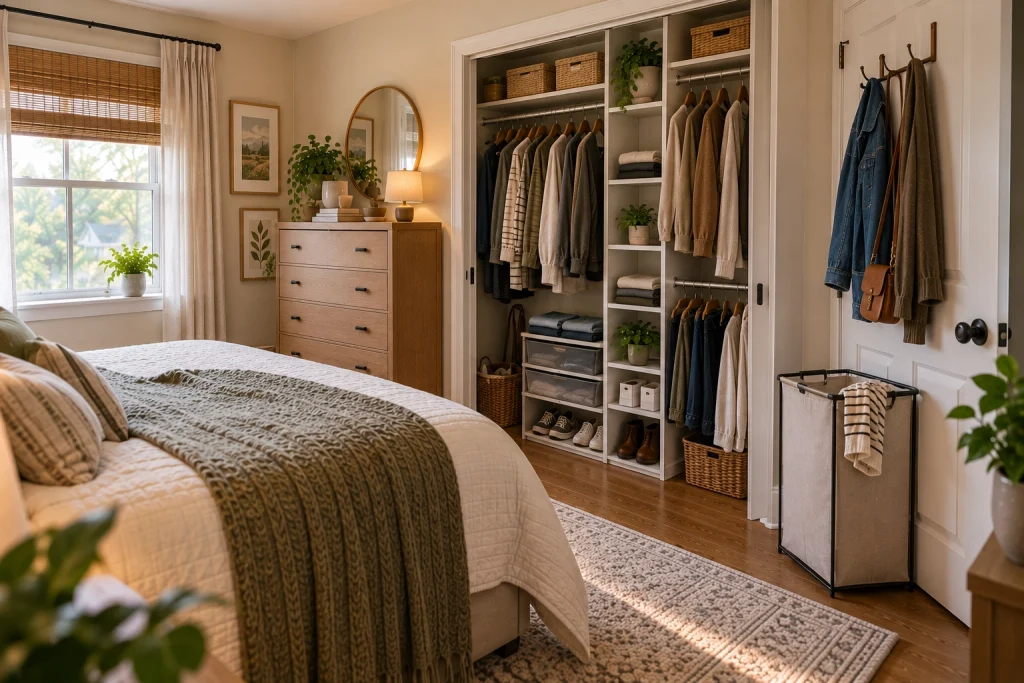
Bags, keys, jackets, wallets, and other daily essentials often end up scattered around a bedroom because there isn’t a designated landing spot.
Create one.
A few hooks, a small section of a dresser, a narrow surface, or a basket can be enough. For a rental, removable hooks or existing furniture may be preferable to permanent installations.
Keep the area deliberately limited. A drop zone should collect the things you use every day—not become a general-purpose dumping ground.
If you regularly come home with the same handful of items, give those items a predictable place to land.
6. Keep Shoes From Taking Over the Floor
Shoes can make a small room feel crowded quickly, particularly when pairs are left wherever they were taken off.
Start by separating everyday shoes from pairs you wear only occasionally. Keep the everyday group convenient and give the rest a defined place in existing closet or bedroom storage.
It’s also worth being realistic about how many pairs need to be immediately accessible.
If the floor is already tight, adding a large shoe cabinet may solve one problem while creating another. Sometimes a smaller, simpler system is the better fit.
7. Give Bags and Purses One Dedicated Spot
Bags tend to move around the room when they don’t have a clear home.
Choose one location for them and keep the collection contained. Hooks work well for frequently used bags because they make them easy to grab. A shelf or closet section may be preferable if you’d rather keep them out of sight.
If you use different bags for work, errands, travel, or exercise, grouping them by purpose can make choosing one faster.
The goal isn’t to display every bag. It’s to stop them from becoming part of the bedroom’s daily clutter.
8. Organize Accessories Where You Can Actually See Them
Small accessories are easy to misplace, especially when they’re mixed together.
Think about the way you use them before choosing where they go. Jewelry you wear every day might work best in a shallow tray. Belts or scarves may be easier to manage on hooks. Less frequently used accessories can go into a drawer or small container.
Avoid putting everything into one deep box. That technically keeps the room tidy, but it doesn’t make finding a particular item any easier.
Good organization should reduce the amount of searching you do.
9. Keep Laundry Under Control
Laundry becomes a bedroom clutter problem when clean clothes, dirty clothes, and “I might wear this again” clothes all end up in the same place.
Start with one obvious location for dirty laundry. A hamper near where you normally change can be more practical than putting it in the most visually convenient corner.
Then deal with the middle category: clothes that aren’t dirty enough to wash but aren’t ready to return to the closet. Give them one designated place rather than allowing a chair to become the default storage solution.
It doesn’t have to be elaborate. It just needs to keep those three categories from becoming one pile.
10. Divide Your Closet by Function
A closet is easier to use when you don’t have to search through everything to find one type of clothing.
Create broad sections based on your routine. For example, everyday tops can occupy one area, work clothes another, and dressier pieces another.
If you share a bedroom, dividing the closet by person may be more practical than mixing everyone’s clothing together.
Don’t worry about making every section look perfect. Consistency matters more. Once you know where each category lives, putting clean clothes away becomes much faster.
11. Use Matching Bins for Small Items
Bins can be useful when they solve a specific problem.
Good candidates include travel accessories, spare charging cables, seasonal accessories, keepsakes, or other small collections that are difficult to keep together.
Use a few meaningful categories rather than creating a separate container for every type of object. If you have to remember which of ten nearly identical boxes contains something, the organization has become harder than the original mess.
Labels can help when the contents aren’t immediately obvious.
12. Organize Items by Category, Not Randomly
An empty drawer or shelf can be tempting when you’re trying to tidy quickly. But putting unrelated things into every available space usually makes the room harder to manage later.
Group similar belongings together instead.
Keep electronics with electronics, accessories with accessories, and reading materials together. That way, you know where to look before you even open a drawer.
This matters most for small objects. When chargers, adapters, batteries, and headphones are scattered across several parts of the room, finding one becomes unnecessarily frustrating.
A useful organization system reduces the number of places you have to search.
13. Make Better Use of Vertical Space
A small bedroom isn’t limited to the floor.
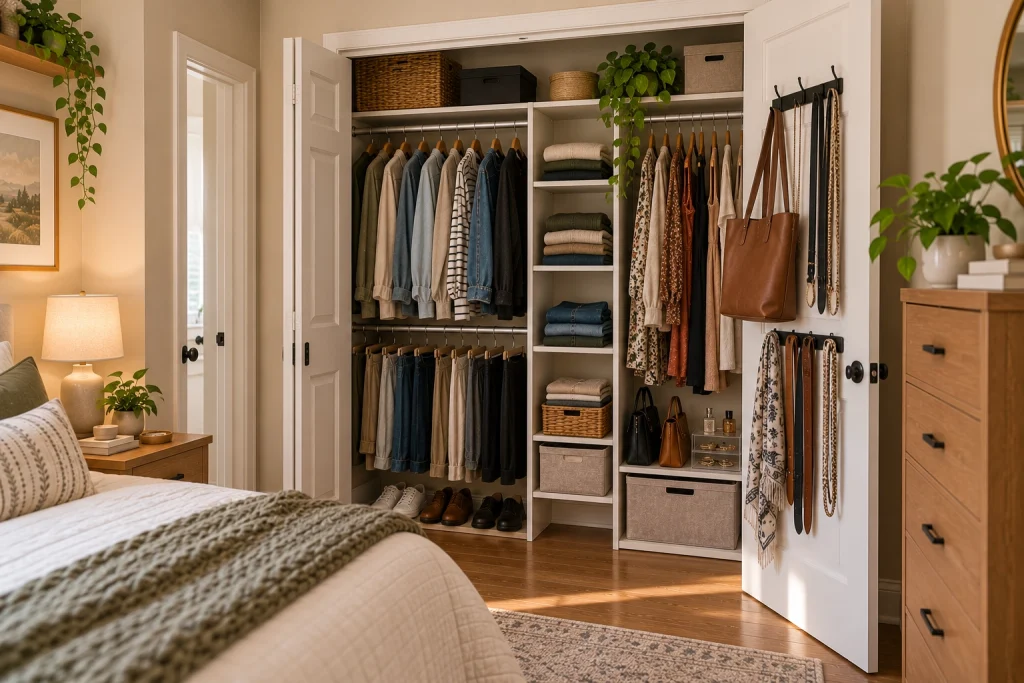
Depending on the room and your rental restrictions, walls, closet doors, the backs of doors, and other vertical areas can sometimes provide useful organization space.
Hooks, over-the-door organizers, tall shelving, and vertical closet accessories can all help keep belongings off the floor.
But don’t fill every empty wall simply because you can. Too much visible organization can make a compact room feel visually busy.
Use vertical space selectively for things that genuinely benefit from being accessible or off the floor.
For a broader look at planning a compact bedroom, our guide to small bedroom ideas covers additional ways to make limited space work.
14. Keep Seasonal Items Separate
The things you use every day deserve the easiest-to-reach space.
That makes seasonal rotation particularly helpful in a small bedroom. When cold-weather accessories aren’t needed, for example, they don’t necessarily need to occupy the most convenient drawer.
Group seasonal clothing and accessories together in an appropriate closet area, under-bed container, or other existing storage space.
When the season changes, you can switch what is easiest to reach rather than trying to make every item equally accessible all year.
15. Create a Simple “Put Away” Routine
Even a good organization system needs a small reset now and then.
A five-minute routine might be enough:
- Put dirty clothes in the hamper.
- Return shoes to their usual spot.
- Put bags and everyday essentials away.
- Clear the nightstand.
- Remove anything that belongs elsewhere.
The timing matters less than consistency. You might prefer doing it before bed, while getting ready in the morning, or at another natural point in your day.
The best routine is the one that fits into something you already do rather than becoming another task you have to remember.
16. Organize Under-Bed Items Properly
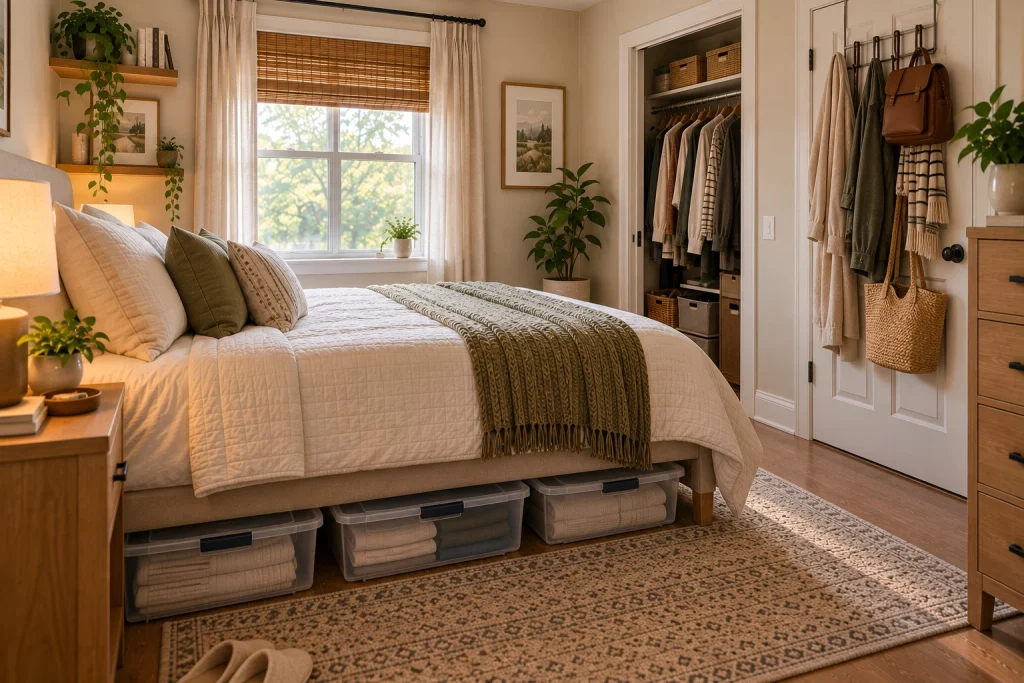
Under-bed space is useful when it has a purpose. Without one, it can quickly become a hiding place for things you don’t know where else to put.
Reserve it for belongings you don’t need every day, such as seasonal clothing, spare bedding, or occasionally used personal items.
Whatever you store there should remain reasonably accessible. If you have to pull out several unrelated containers just to reach one item, the system needs rethinking.
For a deeper look at adding and using storage in a small bedroom, see our small bedroom storage ideas.
17. Keep Bedroom Surfaces Mostly Clear
A dresser doesn’t need to be completely bare. But when every surface becomes a place for receipts, clothing, skincare, cables, mail, and random household items, the room becomes harder to reset.
Give each surface a primary job.
A dresser might handle personal items. A desk might handle work supplies. A nightstand might handle nighttime essentials.
If the same type of clutter keeps returning to one surface, don’t just keep clearing it. Ask why that item has nowhere else to go.
That question often reveals the real organization problem.
18. Create a Small Cleaning Station
You don’t need a full collection of cleaning supplies in your bedroom.
Keep a few things you actually use—perhaps a microfiber cloth, lint roller, or compact duster—together in one convenient location.
This makes small maintenance tasks easier to handle when you notice them.
The point isn’t to create another storage category. It’s to keep basic cleaning from requiring a trip around the house every time you see dust or lint.
19. Give Electronics a Dedicated Home
Chargers, headphones, adapters, power banks, and cables can quickly become visual clutter in a small bedroom.
Choose one area for electronics and divide it by frequency of use.
Keep the cables you use regularly easy to reach. Store duplicates and rarely used accessories together rather than letting them spread across the room.
A drawer, small box, or section of a desk can work. The best option depends on your furniture and routine.
The goal is simply to make “Where’s my charger?” a question with an obvious answer.
20. Remove Things That Don’t Belong in the Bedroom
Sometimes organization begins with subtraction.
Bedrooms often collect dishes, paperwork, shopping bags, unopened packages, exercise equipment, tools, and other objects that belong somewhere else.
As you organize, create a small “belongs elsewhere” pile. Once you’re finished sorting, return those items to their proper rooms.
This prevents your bedroom organization system from having to accommodate things that were never meant to live there.
If something repeatedly ends up in the bedroom because it’s convenient, that may be a sign that the rest of the home needs a better place for it.
21. Make Your Organization System Easy Enough to Maintain
The best system is rarely the most elaborate one.
If folding every item in a particular way takes too long, you may stop doing it. If putting a bag away requires moving several things first, the bag will eventually end up on the floor again.

Pay attention to those points of friction.
Maybe frequently worn clothes need to move closer to the front of the closet. Maybe accessories need to be visible rather than buried in a box. Maybe you simply have more belongings than the available space can comfortably handle.
A small bedroom doesn’t need a complicated organizational system. It needs one that makes the tidy choice the easy choice.
7 Small Bedroom Organization Mistakes That Make Clutter Come Back
1. Buying Organizers Before Sorting Your Belongings
Containers can make a mess look neater without actually reducing it.
Better approach: Sort first. Once you know what you’re keeping and what categories you need, decide whether additional organizers are necessary.
2. Creating Too Many Categories
A system with dozens of tiny categories can turn putting something away into a daily decision.
Better approach: Keep categories broad enough that you can remember them without thinking.
3. Prioritizing Appearance Over Accessibility
A storage spot may look tidy but be frustrating to use.
Better approach: Put frequently used belongings where you can reach them easily, even if that isn’t the most visually perfect arrangement.
4. Treating Temporary Piles as a System
A chair or corner can quietly become permanent storage.
Better approach: Identify recurring piles and give those belongings a proper home.
5. Organizing Around an Idealized Routine
A system designed for someone else’s habits won’t necessarily work in your bedroom.
Better approach: Pay attention to what you actually do every day and organize around those behaviors.
6. Ignoring the “Wear Again” Category
Not every piece of clothing is immediately dirty or ready to return to the closet.
Better approach: Give lightly worn clothing one defined place so it doesn’t automatically become chair clutter.
7. Making the System Too Complicated
A system that requires constant maintenance eventually becomes another source of frustration.
Better approach: Remove unnecessary steps and make putting things away as straightforward as possible.
How to Organize a Small Bedroom From Scratch
If the room feels overwhelming, don’t try to perfect everything in one pass.
1. Remove Obvious Clutter
Start with trash, dishes, packaging, and anything that clearly belongs somewhere else.
2. Group Similar Belongings
Bring clothing, shoes, accessories, electronics, paperwork, and other categories together so you can see what you’re working with.
3. Decide What Actually Belongs in the Bedroom
Not everything needs to stay simply because there happens to be an empty corner or drawer.
4. Identify the Items You Use Every Day
These belongings should receive the most convenient locations.
5. Assign a Home to Everyday Items
Start with whatever repeatedly causes clutter: bags, shoes, chargers, laundry, jewelry, or clothing.
6. Organize Existing Storage
Now arrange closets, drawers, shelves, and under-bed areas according to the categories you’ve already established.
7. Create Simple Routines
Choose a realistic reset point during your day and keep it short.
8. Reassess What Is Still Difficult to Maintain
After using the system for a while, notice what keeps ending up out of place. That’s usually the part of the system that needs changing.
Small Bedroom Organization Checklist
- Everyday items have a designated home
- Frequently worn clothes are easy to reach
- Clothing is grouped in a way that fits your routine
- Shoes have a clear location
- Bags and purses have a designated spot
- Accessories are easy to find
- Dirty laundry has a clear place
- Lightly worn clothing has a defined home
- Closet space is divided logically
- Seasonal belongings are separated when useful
- Small items are grouped by category
- Electronics and chargers have a designated area
- The nightstand holds only useful essentials
- Bedroom surfaces are reasonably easy to clear
- Under-bed storage has a specific purpose
- Things that belong elsewhere have been removed
- The organization system is simple enough to maintain
- The room can be reset without a major cleaning session
Frequently Asked Questions
How do I organize a very small bedroom?
Start by deciding what actually belongs in the room, then group similar belongings and prioritize the things you use most often. Give everyday items convenient homes and keep occasional belongings in less accessible areas.
How can I keep a small bedroom from getting cluttered?
Give recurring clutter a specific home and build a short reset into your routine. It’s also important to remove things that don’t belong in the bedroom instead of continually trying to find space for them.
What should I organize first in a small bedroom?
Start with the category creating the most daily frustration. For many people, that’s clothing, laundry, shoes, the nightstand, or items that accumulate on the floor.
How do I organize clothes in a small bedroom?
Group clothes according to how you use them. Keep frequently worn pieces easy to reach, separate seasonal clothing when practical, and create logical sections for work, casual, and occasional clothing if those categories fit your wardrobe.
How can I organize a small bedroom without buying storage?
Start by sorting and removing belongings that don’t belong, then reorganize the closet, drawers, shelves, and existing furniture. You may be able to create a much better system simply by changing where things live.



2 comments