In this article
- 1. Start With One Clear Color Direction
- 2. Let the Bedding Do More of the Decorating
- 3. Add a Rug That Fits the Room Properly
- 4. Use Curtains to Soften the Windows
- 5. Give the Bed Wall One Focal Point
- 6. Add Wall Art Without Filling Every Wall
- 7. Use One or Two Textured Elements
- 8. Layer Different Sources of Lighting
- 9. Choose a Small Number of Decorative Objects
- 10. Add a Mirror Where It Actually Helps
- 11. Use Greenery Without Turning the Room Into a Jungle
- 12. Coordinate Wood and Furniture Finishes
- 13. Make the Nightstand Look Intentional
- 14. Use a Bench or Small Accent Piece Only If It Fits
- 15. Hide Everyday Clutter Before Adding More Decor
- 16. Repeat One Accent Color Instead of Adding Many
- 17. Leave Some Surfaces Empty
- 18. Add One Personal Detail That Makes the Room Yours
- 19. Finish With a Simple “Edit” Instead of More Stuff
- How to Put These Ideas Together
- Final Thoughts
19 Small Bedroom Decor Ideas That Make a Room Feel Finished
A small bedroom can be perfectly functional and still feel like something is missing. You may have the bed, storage, and basic furniture in place, yet the room can still look plain, disconnected, or unfinished.
The solution isn’t necessarily adding more furniture or filling every empty surface with decor. In a small room, a few intentional choices usually work better than a lot of small ones. Bedding, lighting, curtains, artwork, color, texture, and even a little empty space can make the room feel much more complete without making it feel crowded.
The key is to decorate according to the room’s scale. Instead of asking what else you can fit into the bedroom, ask which details will make the space feel more cohesive and personal.
Here are 19 small bedroom decor ideas that can help you get there.
1. Start With One Clear Color Direction
Before adding decorative pieces, decide what visual direction you want the room to follow.
That doesn’t mean everything needs to be the exact same color. A simple palette might include a soft neutral as the base, a slightly deeper secondary tone, and one accent color that appears in a few places.
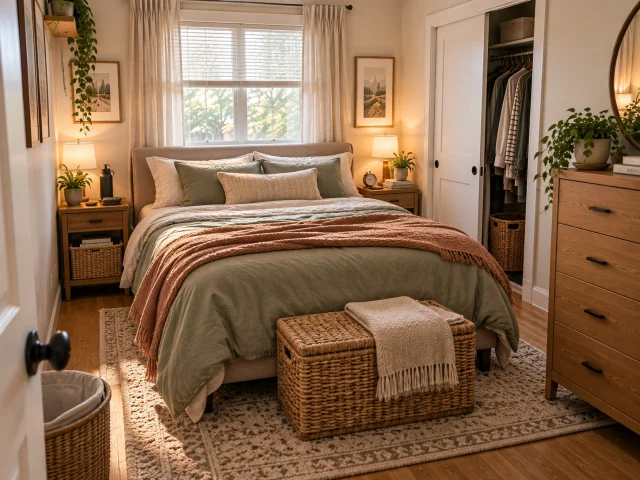
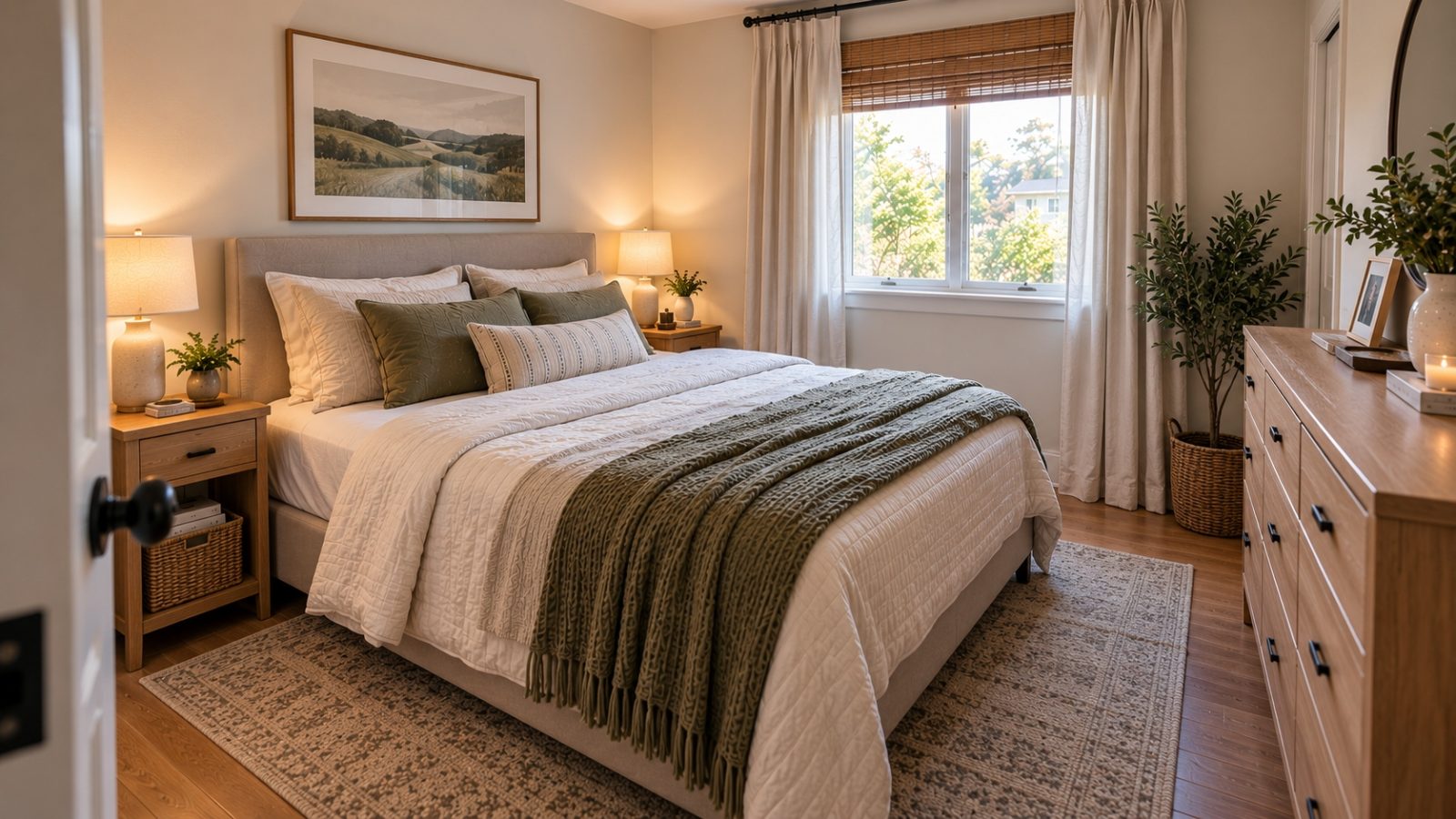
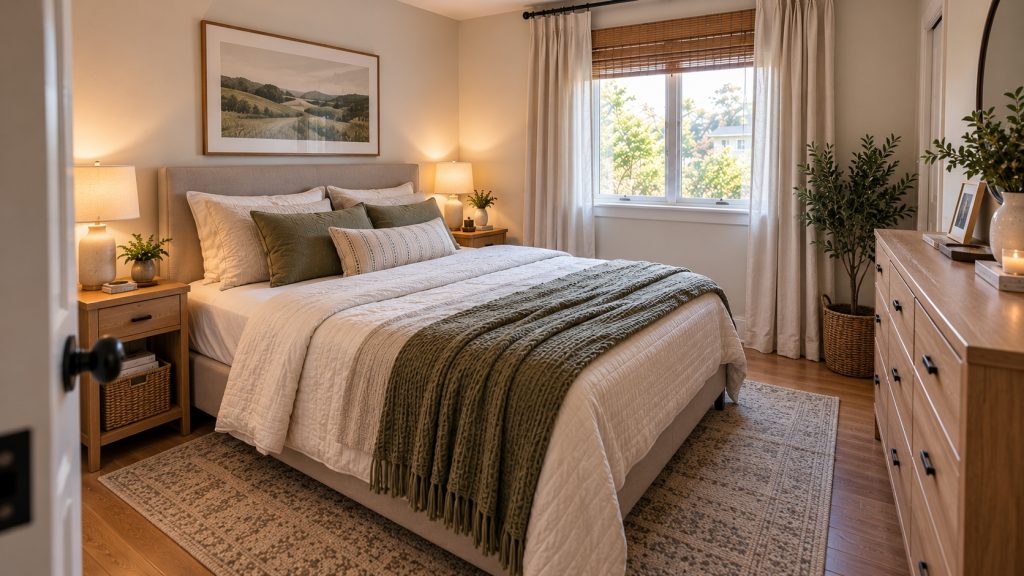
For example, a bedroom could combine warm white walls, natural wood, beige textiles, and muted green accents. The individual pieces don’t need to match perfectly. They just need to feel like they belong together.
This is especially useful in a small bedroom because there are fewer visual areas to work with. Random colors can make the room feel busier than it actually is.
Try this: Choose one main neutral, one supporting color, and one accent. Then use them repeatedly rather than introducing a new color every time you add something.
2. Let the Bedding Do More of the Decorating
In a small bedroom, the bed is usually the largest visual element in the room. That makes bedding one of the easiest ways to change the overall look without adding another piece of furniture.
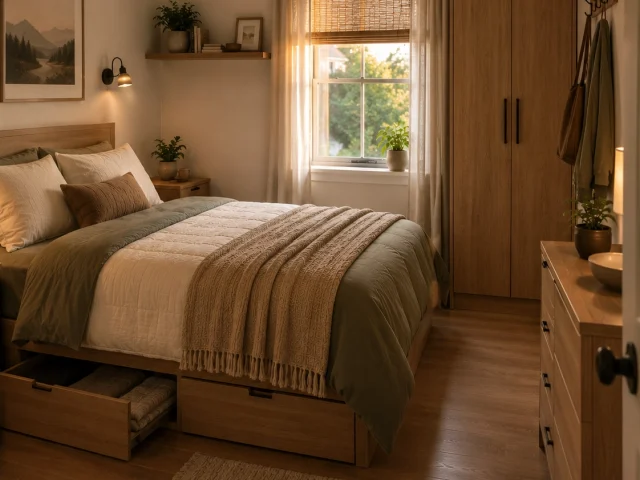
Start with a simple base and build some texture with a duvet or comforter, a folded throw, and a small number of pillows. You don’t need a dozen decorative pillows to make the bed look finished.
A textured duvet cover or a subtle pattern can also give the room more personality while keeping the rest of the decor relatively simple.
Keep in mind: If your bedding already has a strong pattern or color, let it be the focal point instead of competing with it using equally bold artwork, curtains, and accessories.
3. Add a Rug That Fits the Room Properly
A rug can make a small bedroom feel more visually connected, but size matters.
A very small rug floating in front of the bed can look disconnected from the rest of the furniture. Depending on the room’s dimensions, a larger rug partially underneath the bed can create a more cohesive visual area.
If a full-size rug isn’t practical, a smaller runner can work beside the bed instead.
Think about how the rug relates to the bed rather than choosing one based only on how it looks by itself.
Before buying: Measure the available floor area and check how much clearance you’ll have around the bed, doors, and other furniture.
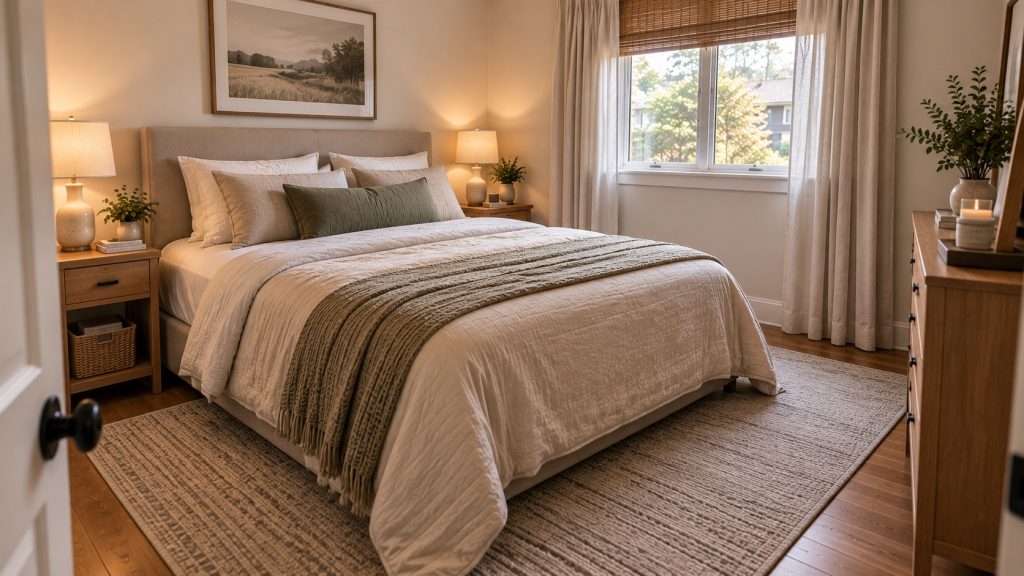
4. Use Curtains to Soften the Windows
Curtains can make a bedroom feel more finished without taking up meaningful floor space.
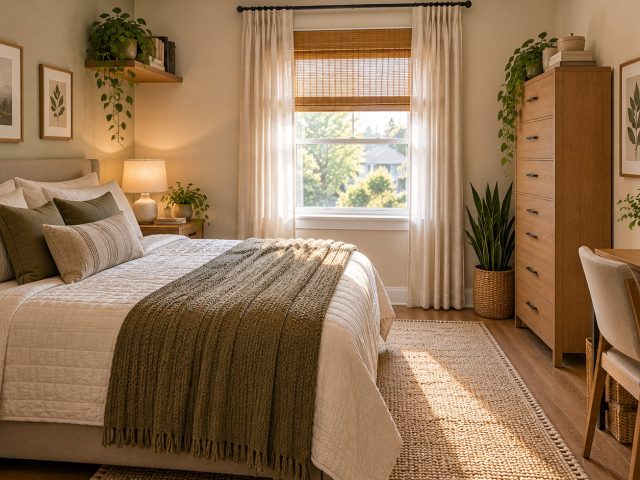
For a clean look, choose a curtain color that relates to the room’s existing palette rather than introducing an unrelated shade. A lightweight fabric can also keep the window area from feeling visually heavy.
Pay attention to length and placement. Curtains that look too short or are poorly proportioned can make an otherwise carefully decorated room feel unfinished.
If privacy or light control is important, consider layering a more functional window covering with decorative curtains rather than relying on appearance alone.
5. Give the Bed Wall One Focal Point
You don’t need to decorate every wall.
In fact, choosing one wall as the room’s visual anchor can make decorating much easier. In many bedrooms, the wall behind the bed is the natural place to do this.
A focal point could be:
- one large piece of artwork
- a simple arrangement of framed prints
- a subtle accent wall
- a visually interesting headboard
- a restrained decorative feature
The important part is choosing one direction instead of combining several competing focal points.
If the bed already has a strong headboard, for example, you may not need a large gallery wall behind it.
6. Add Wall Art Without Filling Every Wall
Wall art can add personality to a small bedroom, but more isn’t automatically better.
Choose artwork that works with the room’s colors and scale. One larger piece can sometimes feel cleaner than several tiny pieces scattered around the room.
You can also create a small, intentional grouping rather than trying to fill every available section of wall.
Leave some wall space visible.
That empty area isn’t wasted space—it gives the artwork somewhere to stand out.
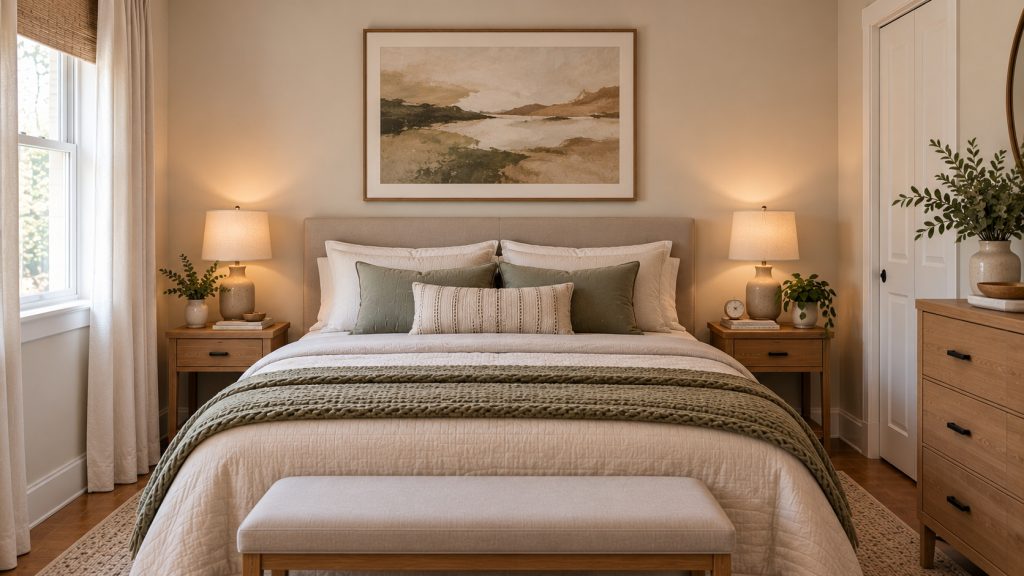
7. Use One or Two Textured Elements
Small bedrooms can sometimes look flat when every surface has the same smooth finish.
You don’t need to add lots of decor to solve that. One or two textured elements can be enough.
Consider:
- a woven throw
- a textured pillow
- a natural-fiber basket
- a soft upholstered element
- a subtly textured curtain
Texture is particularly useful when your color palette is restrained. Different materials can create visual interest without requiring additional colors.
The trick is restraint. If every item has a dramatic texture, the room can start to feel visually noisy.
8. Layer Different Sources of Lighting
A single overhead light can make a bedroom functional, but it doesn’t always make it feel finished.
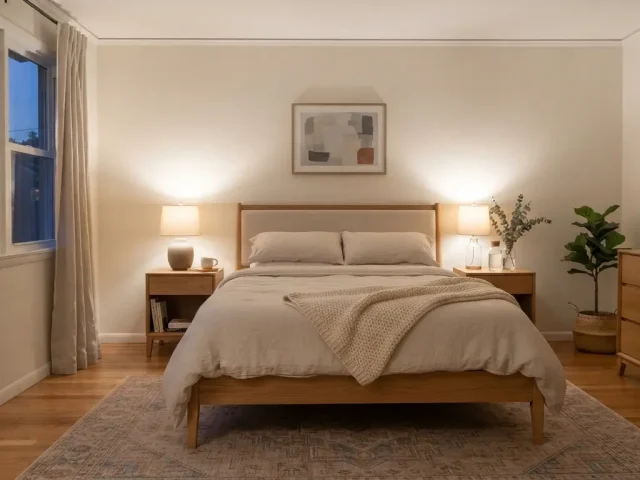
Where space allows, combine different types of lighting for different needs. A bedside lamp can provide focused light for reading, while softer ambient lighting can make the room feel more comfortable in the evening.
Think about the room in layers:
General light → bedside/task light → softer ambient light
You don’t necessarily need multiple large fixtures. In a small bedroom, compact lamps and appropriately sized fixtures can accomplish the same goal without overwhelming the space.
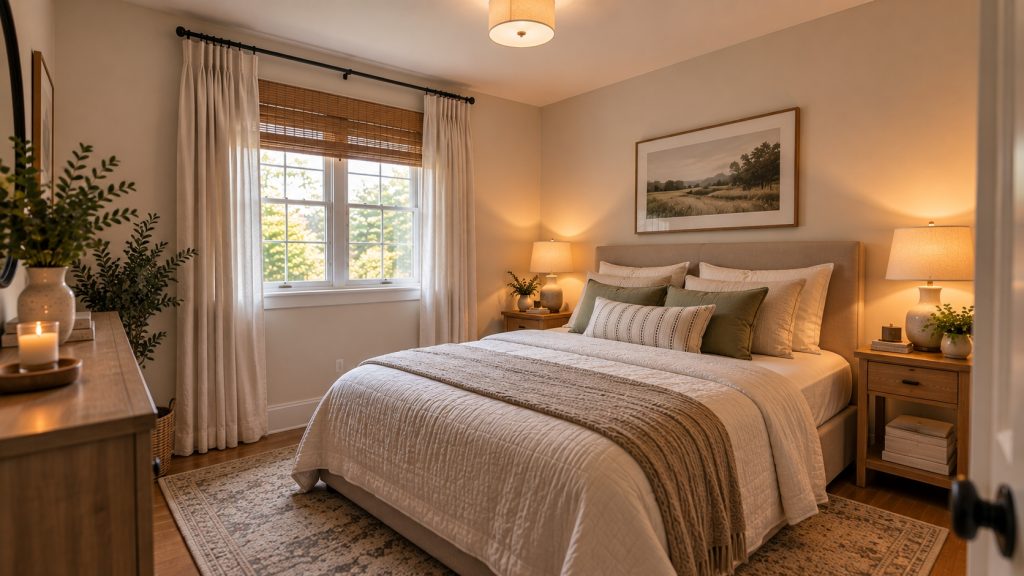
9. Choose a Small Number of Decorative Objects
One of the easiest ways to make a small bedroom feel crowded is to decorate every available surface.
Instead, choose a few objects that actually contribute to the room’s look.
A nightstand might only need a lamp, a book, and one small decorative object. A dresser could have one tray or vase rather than a collection of unrelated items.
This creates a more intentional appearance and makes the pieces you do choose more noticeable.
A useful rule is to style, step back, and remove one thing if the surface starts feeling busy.
10. Add a Mirror Where It Actually Helps
A mirror can be both decorative and practical.
Instead of automatically adding a large mirror because the bedroom is small, consider what the mirror will actually do for the room.
A wall mirror can be useful near a dressing area, while a full-length mirror can make sense where there is enough clearance to use it comfortably.
Placement matters more than simply owning one. Avoid putting a mirror somewhere that creates an awkward reflection or interferes with the room’s everyday use.
And remember: the goal here is not to rely on a mirror as a magic trick to make a room look larger. Choose one because it works with the room and your routine.
11. Use Greenery Without Turning the Room Into a Jungle
A little greenery can make a bedroom feel more alive and personal.
In a small room, one appropriately sized plant can be more effective than several large ones competing for attention.
You could place a small plant on a dresser, use a compact floor plant if you have enough clearance, or choose a simple planter that complements the room’s existing finishes.
If caring for a live plant doesn’t fit your routine, a well-made artificial plant can provide a similar decorative role.
The goal is to add a natural element—not another source of clutter.
12. Coordinate Wood and Furniture Finishes
Your furniture doesn’t have to come from the same collection, but completely unrelated finishes can make a small bedroom feel visually fragmented.
Look at the dominant finishes already in the room.
If you have warm natural wood, for example, adding several unrelated cool-toned finishes may make the space feel less cohesive. You can still mix materials, but repeating one or two finishes helps create continuity.
This doesn’t mean everything needs to match.
A little variation can make a bedroom feel more natural. The goal is simply to make the differences look intentional.
13. Make the Nightstand Look Intentional
The nightstand is small, but because it sits next to the bed, it has a noticeable effect on the overall appearance of the room.
Instead of filling it with everything you use during the day, give the surface a simple visual hierarchy.
For example:
- lamp
- book
- small tray
- one decorative object
Leave some surface visible.
If you need more everyday items nearby, use the nightstand’s drawers or another appropriate storage solution rather than turning the top into a permanent collection of chargers, receipts, bottles, and miscellaneous objects.
The goal is styled, not sterile.
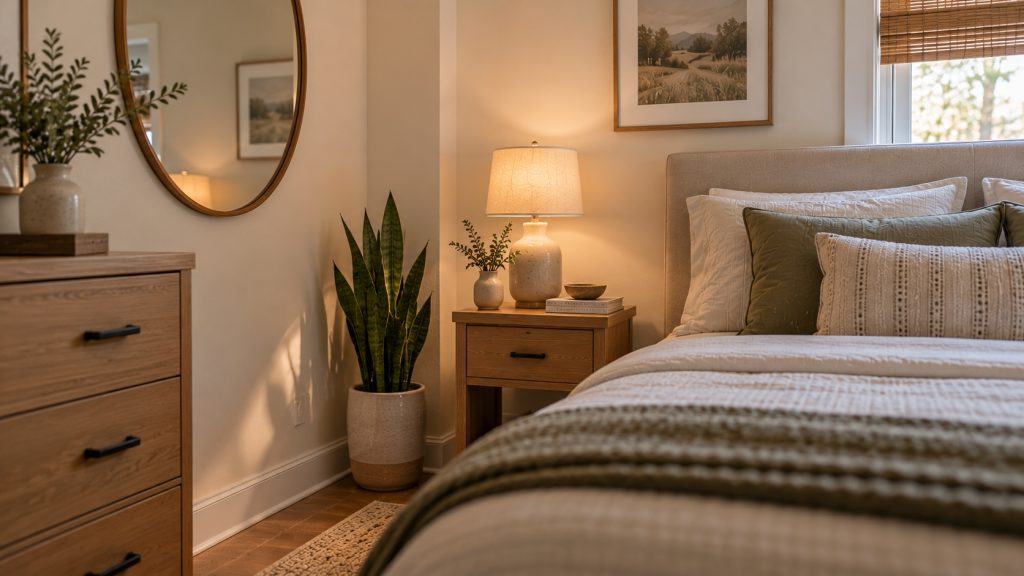
14. Use a Bench or Small Accent Piece Only If It Fits
An empty corner doesn’t automatically need furniture.
A small bench, stool, or accent chair can add function and personality, but only if there is enough room to use it without making the bedroom harder to move through.
Before adding one, consider:
- walking clearance
- door swing
- bed access
- existing furniture
- whether you’ll actually use it
If the answer is no, leaving the space empty may be the better decorating decision.
In a small bedroom, restraint is often part of good design.
15. Hide Everyday Clutter Before Adding More Decor
Sometimes a bedroom looks unfinished not because it needs decoration, but because everyday clutter is competing with the decoration already there.
Look at the things that tend to accumulate:
- loose clothing
- laundry
- chargers
- packaging
- random papers
- miscellaneous objects
Deal with those first.
You may discover that the room already has enough decorative elements and simply needs clearer surfaces.
This is different from adding more storage. The point is to edit what is visible before deciding what else the room needs.
For more practical ways to organize belongings in a compact bedroom, see our guide to small bedroom organization ideas.
16. Repeat One Accent Color Instead of Adding Many
A single accent color can help tie a room together.
For example, if you choose muted green as the accent, you might repeat it subtly in a pillow, a piece of artwork, and a small decorative object.
The repetition doesn’t have to be exact.
What matters is that the eye recognizes a visual relationship between different parts of the room.
This approach can make individual decorative pieces feel like part of one design rather than separate purchases collected over time.
17. Leave Some Surfaces Empty
Empty space is part of the design.
You don’t need to fill every dresser, shelf, nightstand, or wall simply because there’s room available.
Leaving some surfaces empty gives the eye a place to rest and allows your favorite decorative pieces to stand out.
This is especially valuable in a small bedroom because the room already has a limited visual footprint.
If you’re unsure whether you’ve added enough decor, don’t automatically add another piece. Step back and look at the room as a whole.
Sometimes the missing finishing touch is actually removing something.
18. Add One Personal Detail That Makes the Room Yours
A bedroom can be beautifully styled and still feel generic.
One personal detail can change that.
It could be:
- a framed photograph
- meaningful artwork
- a favorite book
- a handmade object
- a small travel souvenir
- something connected to a hobby
The point isn’t to display everything you own.
Choose one or two things that have genuine meaning to you. Personal details work best when they feel naturally integrated into the room rather than placed there simply to make it look decorated.
19. Finish With a Simple “Edit” Instead of More Stuff
Once you’ve decorated the room, stop adding things for a moment.
Walk around and look at the bedroom as a whole.
Ask yourself:
- Does anything feel visually out of place?
- Are there too many small objects competing for attention?
- Is the accent color repeated enough to feel intentional?
- Can the room still be used comfortably?
- Are any surfaces unnecessarily crowded?
- Does the decor actually reflect the way the room is used?
Then remove anything that doesn’t contribute.
This final edit can be what separates a bedroom that is simply decorated from one that feels finished.
How to Put These Ideas Together
You don’t need to use all 19 ideas at once.
A better approach is to build the room in layers.
Start with the large visual elements: color direction, bedding, curtains, and rug. These establish the foundation without requiring lots of small accessories.
Next, create one or two focal areas, such as the bed wall and bedside lighting. Then add a small amount of texture, greenery, artwork, or personal decor.
Finally, step back and edit.
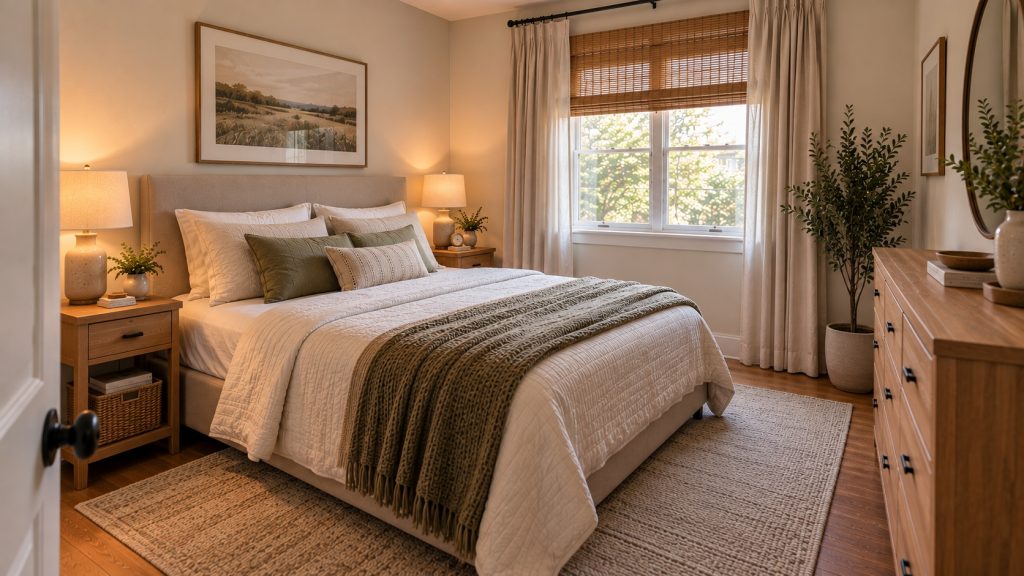
For example, a small bedroom might use:
- warm white as the base color
- natural wood furniture
- beige bedding
- one muted accent color
- a properly sized rug
- simple curtains
- one large piece of artwork above the bed
- two compact bedside lamps
- one small plant
- a few personal objects
That’s enough to make the room feel considered without filling every corner.
If the room still feels crowded, resist the temptation to solve it by buying more furniture or decor. Our guide to small bedroom layout ideas can help if the problem is how furniture is positioned, while our guide to small bedroom storage ideas covers ways to handle belongings without relying on decorative surfaces.
Final Thoughts
A small bedroom doesn’t need a lot of decoration to feel complete.
What usually makes the biggest difference is cohesion and restraint: a clear color direction, comfortable bedding, appropriately sized textiles, useful lighting, a few intentional decorative pieces, and enough empty space for everything to breathe.
Start with the elements that have the biggest visual impact, then add personality gradually. If something makes the room harder to use or simply adds visual noise, it probably doesn’t need to stay.
The goal isn’t to create a bedroom that looks decorated from every angle. It’s to create one that feels comfortable, personal, cohesive, and intentionally finished.