In this article
- 1. Choose Furniture That Fits the Room, Not Just the Bed
- 2. Place the Bed First
- 3. Keep the Main Walking Path Clear
- 4. Swap Bulky Nightstands for Narrower Storage
- 5. Use the Walls for Storage
- 6. Take Storage All the Way Up
- 7. Give Under-Bed Space a Specific Job
- 8. Use One Large Visual Element Instead of Many Small Ones
- 9. Try a Tonal Color Scheme
- 10. Don’t Automatically Paint Everything White
- 11. Use a Mirror Where It Actually Helps
- 12. Let Curtains Extend Beyond the Window
- 13. Choose a Rug That Relates to the Bed
- 14. Use Lighting That Doesn’t Need Floor Space
- 15. Use Furniture With More Than One Job
- 16. Create a Small Bedroom Workspace Without Building a Home Office
- 17. Keep the Bedside Area Visually Light
- 18. Use a Headboard to Add Height Without Adding Furniture
- 19. Keep Small Decorative Objects Together
- 20. Use a Consistent Material or Finish to Connect the Room
- 21. Leave Some Space Empty on Purpose
- How to Arrange Furniture in a Small Bedroom
- Step 1: Place the bed first
- Step 2: Protect the main walking path
- Step 3: Add essential storage
- Step 4: Use walls for secondary functions
- Step 5: Add decoration last
- 5 Small Bedroom Mistakes That Make a Room Feel Smaller
- 1. Furniture That’s Too Large
- 2. Poorly Planned Furniture Placement
- 3. Too Many Small Decorative Objects
- 4. A Rug That’s Too Small for the Furniture Arrangement
- 5. Ignoring Vertical Space
- What Actually Makes a Small Bedroom Feel Bigger?
- Frequently Asked Questions
- What colors make a small bedroom feel bigger?
- How can I make a small bedroom feel less cramped?
- Where should I put my bed in a small bedroom?
- How can I add storage without making a small bedroom feel crowded?
- Is dark paint a bad idea for a small bedroom?
- Final Thoughts
21 Small Bedroom Ideas That Make a Room Feel Bigger
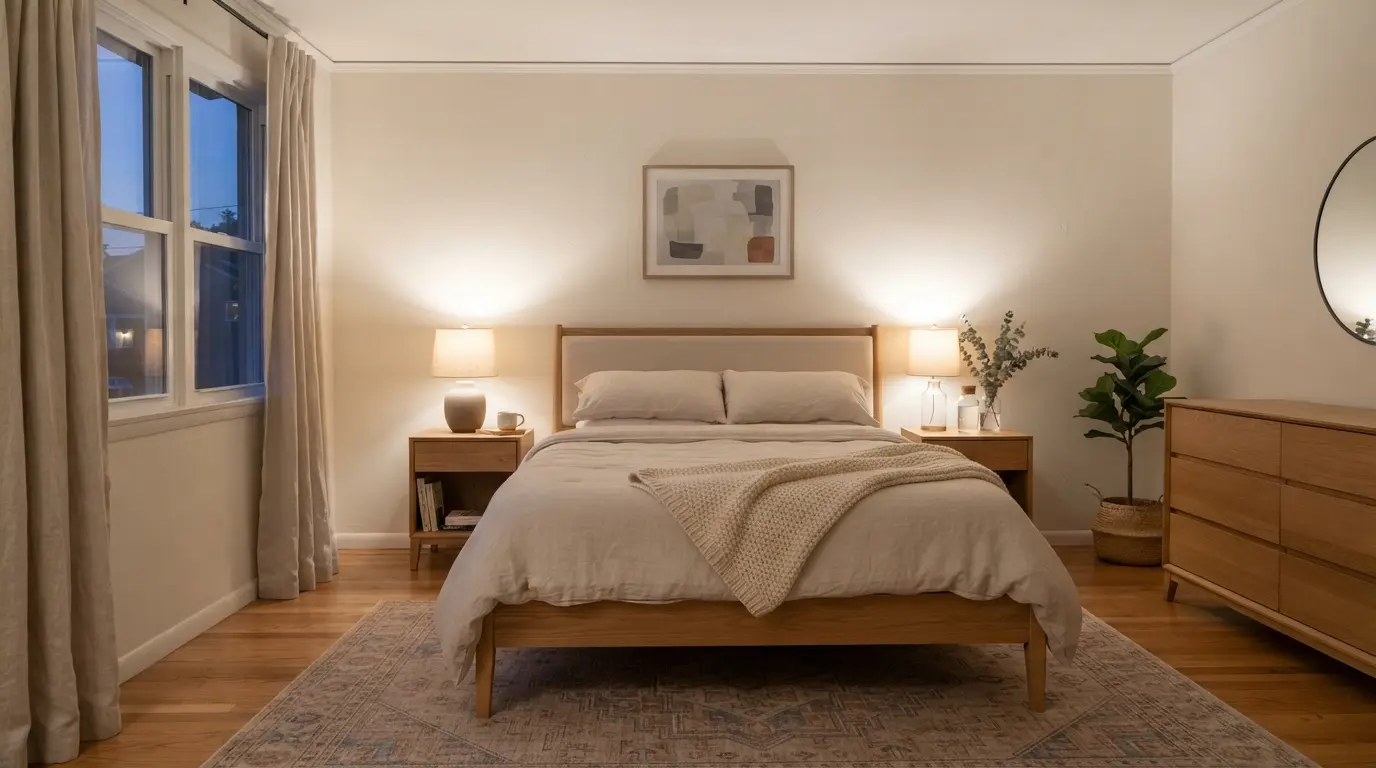
A small bedroom does not need to look empty to feel spacious. In many cases, the problem is not the number of things in the room but the relationship between them: a bed that is too large for the available floor space, storage that sticks out into the walkway, a rug that stops short of the furniture, or too many small objects competing for attention.
The most successful small bedrooms usually feel intentional rather than stripped down. Furniture is scaled to the room, storage has a clear purpose, walls are used intelligently, and the eye is given a few calm areas instead of a collection of disconnected details.
You also do not have to make everything white or replace all your furniture. A better layout, a narrower nightstand, a wall-mounted light, or a more disciplined approach to storage can sometimes change the room more than a full decorating makeover.
Here are 21 small bedroom ideas that focus on making the space work better, look calmer, and feel more open.
1. Choose Furniture That Fits the Room, Not Just the Bed
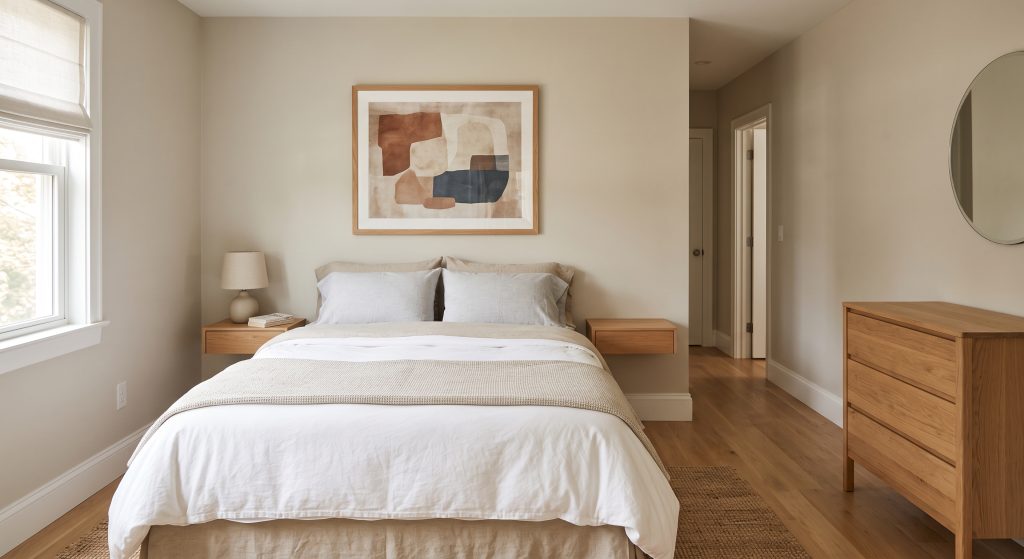
The bed may be the first piece you choose, but it should not automatically determine the entire room.
A large bed with oversized nightstands and a deep dresser can consume nearly all of the usable floor area in a small bedroom. Before buying or replacing anything, measure the room and mark the approximate footprint of each major piece with painter’s tape.
Look at the remaining floor rather than the furniture itself. Can you comfortably reach the closet? Can the bedroom door open fully? Can you get out of bed without immediately encountering another piece of furniture?
If the answer is no, reducing the scale of one or two pieces may make a bigger difference than adding visual tricks later.
2. Place the Bed First
The bed is usually the room’s largest piece, so it should be positioned before everything else.
Start by identifying the walls that allow the bed to sit without blocking doors, windows, closets, or major walking routes. Then test the arrangement with the bed alone before adding nightstands or storage.
Centering the bed on a wall often creates a calmer composition, but symmetry is not more important than function. In an unusually narrow room, shifting the bed slightly may create a much better passage on one side.
Once the bed is in the best practical position, build the rest of the room around it.
For more ideas on creating a warm and comfortable bedroom, see our guide to cozy bedroom ideas
3. Keep the Main Walking Path Clear
One of the easiest ways to make a small room feel cramped is to let furniture interrupt the route you use every day.
Identify the room’s main movement path: usually the route between the door, bed, closet, and bathroom or hallway. Keep that route as direct as possible.
This may mean choosing a narrower dresser, moving a bench, or leaving one side of the bed intentionally open. Do not use every available patch of floor simply because it technically fits another piece of furniture.
A little empty floor can make a small room feel significantly more organized.
4. Swap Bulky Nightstands for Narrower Storage
A traditional nightstand can take up more floor space than its function requires.
If you only need somewhere for a lamp, phone, book, and a few nighttime essentials, look for a compact table, narrow chest, floating shelf, or wall-mounted surface instead.
The important question is not whether a nightstand is attractive. It is whether its storage capacity justifies the amount of floor space it occupies.
For a rental, a small freestanding table is the simplest option. If the room allows more permanent changes, a properly installed floating shelf can free the floor underneath.
5. Use the Walls for Storage
When floor space is limited, the walls become more valuable.
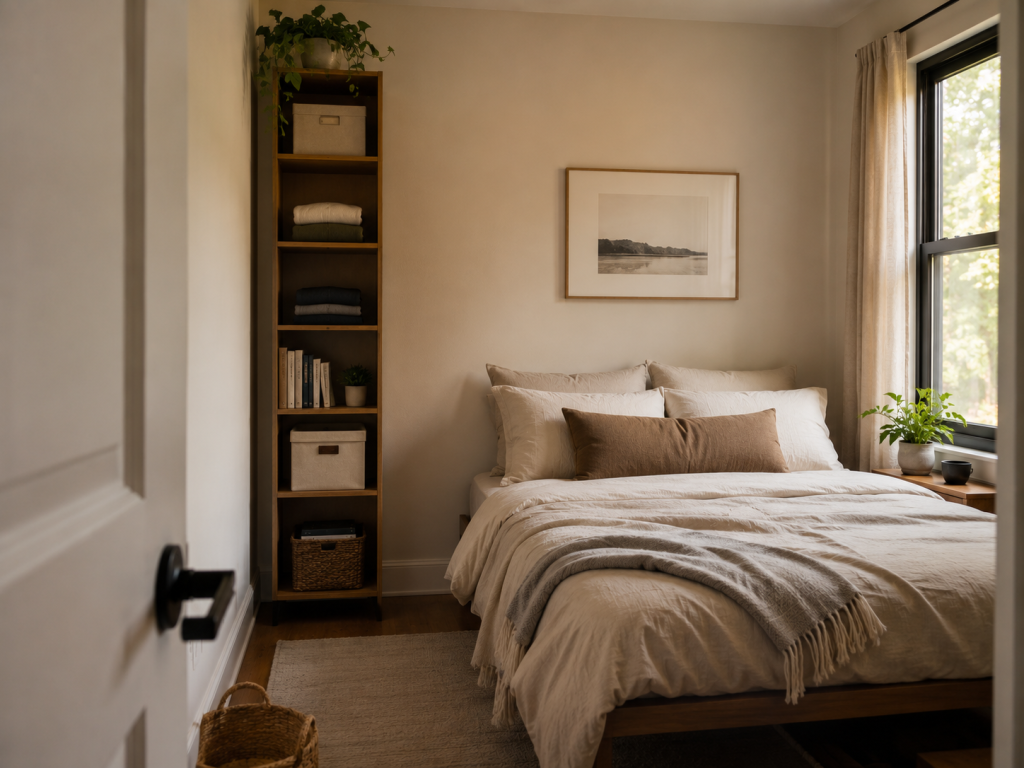
Tall bookcases, wall-mounted shelves, peg-style organizers, hooks, and carefully planned cabinetry can move some storage away from the floor. The key is to use vertical space without turning the walls into a crowded display.
Keep frequently used items within easy reach and place less frequently used belongings higher up.
A tall, relatively narrow storage unit can sometimes be more useful in a small room than a wide, low cabinet that spreads across the floor.
6. Take Storage All the Way Up
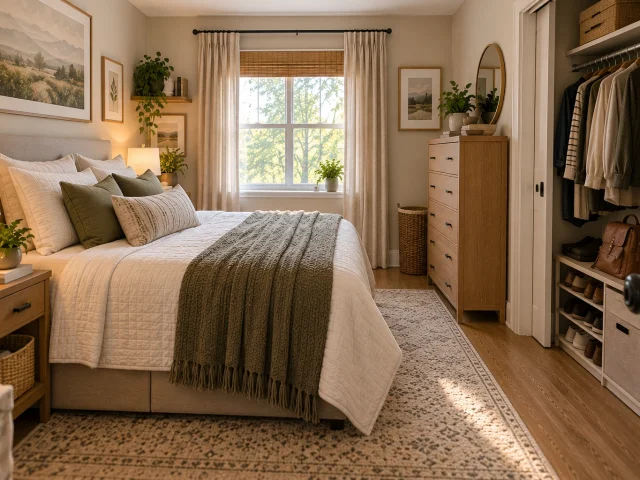
If you have a narrow storage area or built-in closet, consider using its full height rather than stopping at eye level.
The upper sections can hold seasonal clothing, spare bedding, luggage, or other items that do not need to be accessed every day. Everyday items should remain at comfortable heights so the room does not become difficult to maintain.
If you are adding shelving, measure the actual items you intend to store first. Storage is more useful when the shelf heights and depths match what you own.
This approach also helps keep extra boxes and baskets from accumulating on the floor.
7. Give Under-Bed Space a Specific Job
The space underneath the bed is easy to ignore, but it can become useful storage in a small bedroom.
Before putting anything underneath it, decide what belongs there. Seasonal clothing, spare linens, shoes, or luggage are better candidates than objects you use every day.
Use containers that can actually be removed without pulling apart the entire room. If the bed is difficult to access, under-bed storage may become forgotten clutter rather than useful organization.
The goal is not simply to hide more things. It is to keep necessary belongings out of the visible areas that make the room feel crowded.
8. Use One Large Visual Element Instead of Many Small Ones
Small rooms can become visually busy surprisingly quickly.
A wall covered with many tiny frames, shelves, signs, and decorative objects can create more visual noise than one substantial piece of artwork or one larger focal point.
Choose one main element for a wall and allow some surrounding space to remain quiet. This creates a clearer visual hierarchy and reduces the feeling that every surface needs to be decorated.
The same principle applies to the bed. One strong headboard or artwork piece can often do more than several small decorative accents.
9. Try a Tonal Color Scheme
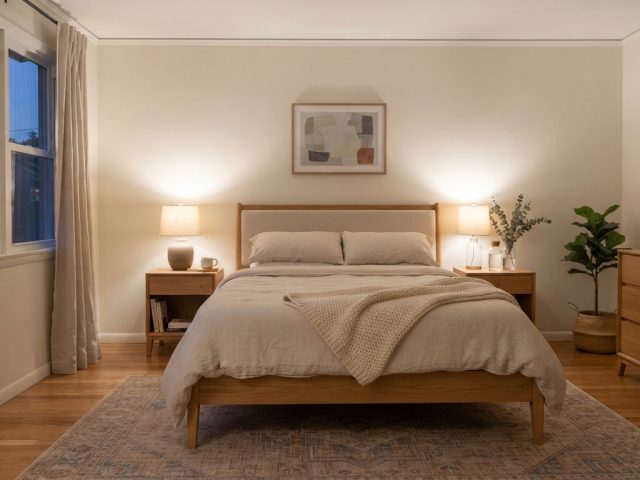
Using several closely related colors can help a small bedroom feel visually continuous.
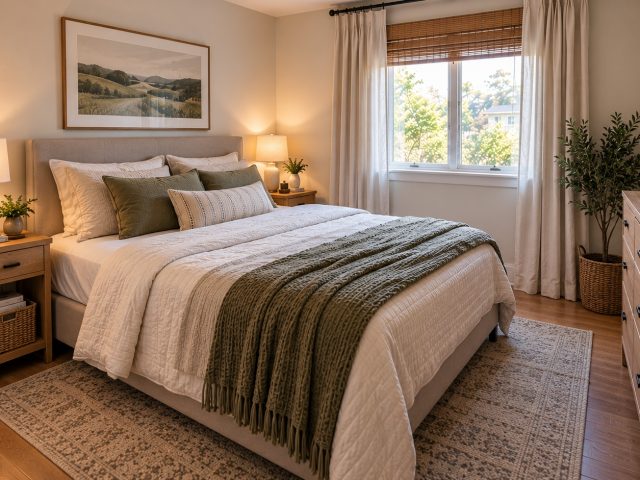
That does not mean every surface needs to be identical. Instead, choose a base color and work within a narrow family of tones. Cream walls might sit alongside oatmeal bedding, warm beige curtains, and light wood.
This approach reduces abrupt visual breaks between surfaces.
You can still introduce contrast through one darker piece of furniture, artwork, or lamp. The aim is not to eliminate contrast but to avoid creating too many competing color blocks.
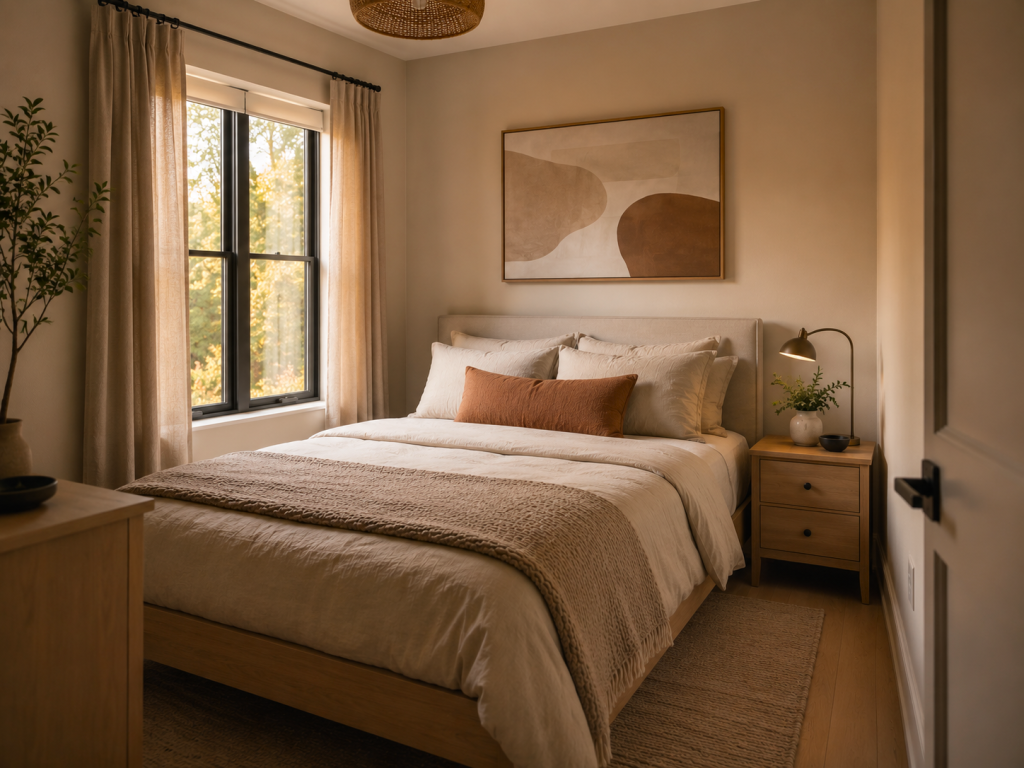
10. Don’t Automatically Paint Everything White
White can work beautifully in a small bedroom, but it is not the only option.
A muted, consistent color can make the room feel more enveloping while reducing the visual fragmentation created by too many contrasting surfaces. Soft sage, warm beige, dusty blue, muted clay, or a gentle gray can all work depending on the existing light and furnishings.
If you prefer a darker or more saturated color, consider using it intentionally rather than assuming small rooms require pale walls.
The more important question is whether the color works with the room’s light, furniture, and textiles as a whole.
11. Use a Mirror Where It Actually Helps
A mirror can be useful in a small bedroom, but placement matters more than size alone.
Instead of placing a mirror simply because there is an empty wall, position it where it reflects daylight, an attractive part of the room, or useful visual space. Avoid reflecting clutter, open storage, or a crowded corner.
A full-length mirror can also combine two functions: making the room useful for getting dressed while adding a reflective surface.
Choose the frame and scale according to the surrounding furniture so the mirror feels integrated rather than like an afterthought.
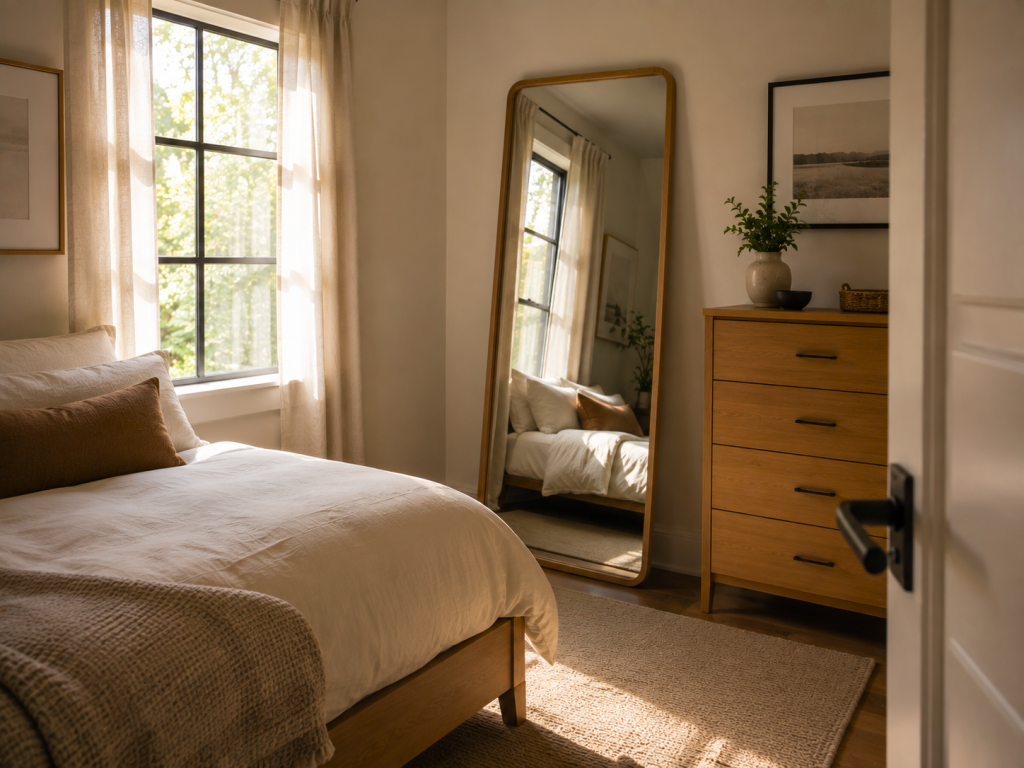
12. Let Curtains Extend Beyond the Window
Curtains can soften a small bedroom without taking up much floor space, but their placement can make a noticeable difference.
If the room allows it, mounting the curtain hardware slightly above and wider than the window can make the window treatment feel more integrated with the wall. Keep the fabric relatively simple so it does not become another heavy visual block.
If floor space is extremely limited, choose a curtain length and mounting position that does not interfere with furniture or heating equipment.
The goal is to frame the window while keeping the surrounding wall visually calm.
13. Choose a Rug That Relates to the Bed
A small rug can sometimes make a small bedroom feel more fragmented if it sits awkwardly between pieces of furniture.
Before choosing a rug, decide what you want it to define. If the goal is to visually anchor the bed, the rug should relate clearly to the bed’s footprint rather than simply fitting into the smallest available patch of floor.
Measure both the room and the furniture arrangement first. If a larger rug would interfere with doors or leave no usable clearance, consider smaller rugs placed where your feet actually land.
The right choice is the one that supports the layout rather than competing with it.
14. Use Lighting That Doesn’t Need Floor Space
Floor lamps can be useful, but they are not always the best solution in a small bedroom.
Wall-mounted sconces or other properly installed wall lights can provide bedside illumination without occupying the floor or reducing the usable surface of a narrow nightstand.
If you cannot make permanent changes, a compact table lamp may still work well. The important thing is to evaluate the entire bedside footprint: lamp, table, cords, and the space needed to move around them.
A smaller light source that fits the room is often more useful than a large decorative fixture.
15. Use Furniture With More Than One Job
When every piece of furniture has only one function, a small bedroom can fill up quickly.
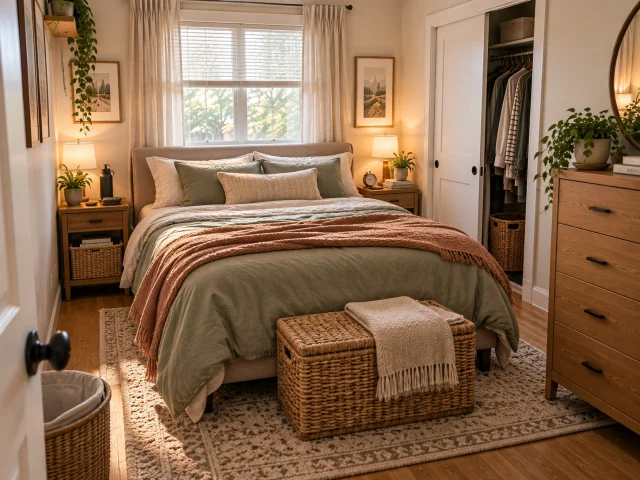
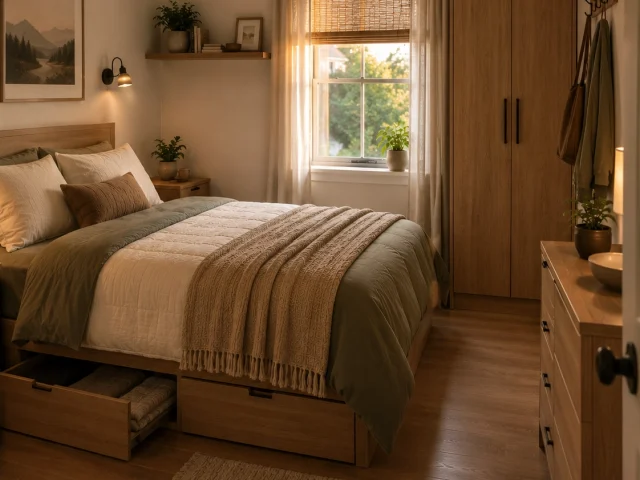
Look for opportunities to combine functions. A bench can provide seating and hold a basket underneath. A desk can double as a getting-ready surface. A bed with built-in drawers can combine sleeping space with additional storage.
This does not mean every object needs to perform multiple tasks. Choose multifunctional furniture where it genuinely solves a problem.
A complicated piece that is difficult to use is not an improvement simply because it saves space on paper.
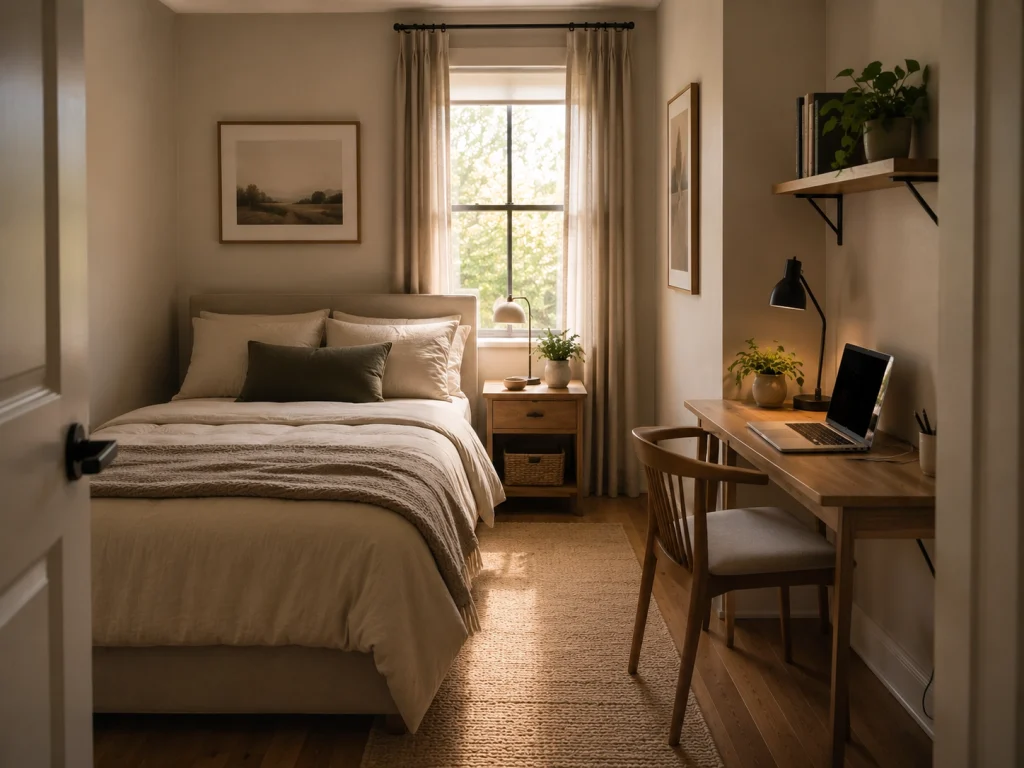
16. Create a Small Bedroom Workspace Without Building a Home Office
If your bedroom needs to accommodate occasional work or study, keep the workspace compact and visually controlled.
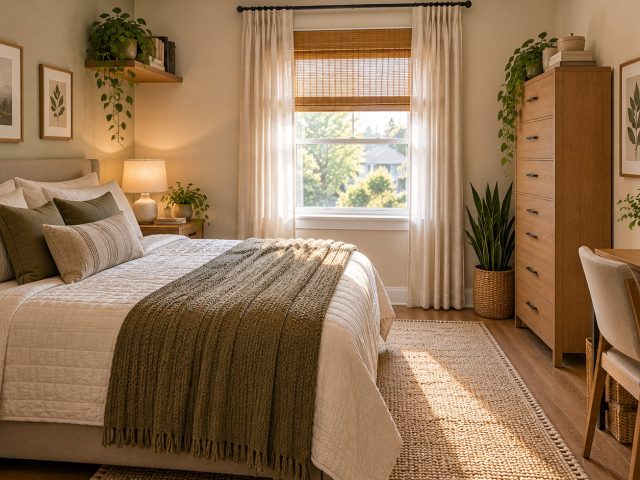
A narrow desk can fit along a suitable wall, while a wall-mounted shelf may provide enough surface for light tasks. Choose a chair that can slide completely underneath when the desk is not in use.
Keep cables and paperwork contained so the workspace does not visually take over the bedroom.
If the desk is directly beside the bed, use consistent colors and materials so the two areas feel connected rather than like unrelated zones.
17. Keep the Bedside Area Visually Light
The area immediately around the bed is one of the first places the eye notices.
Instead of filling both sides with tall furniture, lamps, books, baskets, plants, and decorative objects, decide which functions are essential.
A lower-profile nightstand, lighter-colored furniture, or wall-mounted lighting can reduce the visual weight around the bed.
You do not need to make the entire room minimal. Simply keeping the bed’s immediate surroundings relatively open can create a stronger sense of space.
18. Use a Headboard to Add Height Without Adding Furniture
A small bedroom does not necessarily need a large collection of wall decor to feel finished.
A vertically proportioned headboard can give the bed a clear focal point and draw attention upward. This is particularly useful when the surrounding walls need to remain relatively simple.
Choose a headboard that fits the room’s width and does not create unnecessary depth. A very deep or oversized design can defeat the purpose by consuming floor space.
If a headboard is not practical, a well-scaled artwork piece or vertical wall treatment can create a similar visual emphasis.
19. Keep Small Decorative Objects Together
Several small objects scattered across a bedroom can make it feel busier than the same number of objects grouped intentionally.
Instead of placing small accessories on every surface, create one or two controlled areas. A tray on the dresser can contain a few everyday items, while a single shelf can hold books and one decorative piece.
This makes the room easier to reset because you know where things belong.
Small bedrooms benefit from visible boundaries. When every object has a place, the room can contain personality without looking chaotic.
20. Use a Consistent Material or Finish to Connect the Room
Small rooms can feel disjointed when every piece of furniture introduces a completely different material, wood tone, or finish.
Choose one or two recurring materials and let them appear in several areas. For example, natural wood might connect the bed frame, nightstand, and picture frames. Black metal might repeat through the lamp and a small furniture detail.
This does not mean everything needs to match. A few repeated finishes are enough to create continuity.
When the room feels visually connected, you can keep more personality without making the space look crowded.
21. Leave Some Space Empty on Purpose
Empty space is not wasted space in a small bedroom.
An open section of wall, a clear corner, or an unobstructed stretch of floor gives the eye somewhere to rest. It also makes the practical parts of the room easier to use.
Before adding another decorative piece, ask what problem it solves. If the answer is simply that the wall looks empty, leaving it empty may actually be the better design choice.
A small bedroom does not need to imitate a large bedroom with fewer square feet. It works best when every visible element has a reason to be there.
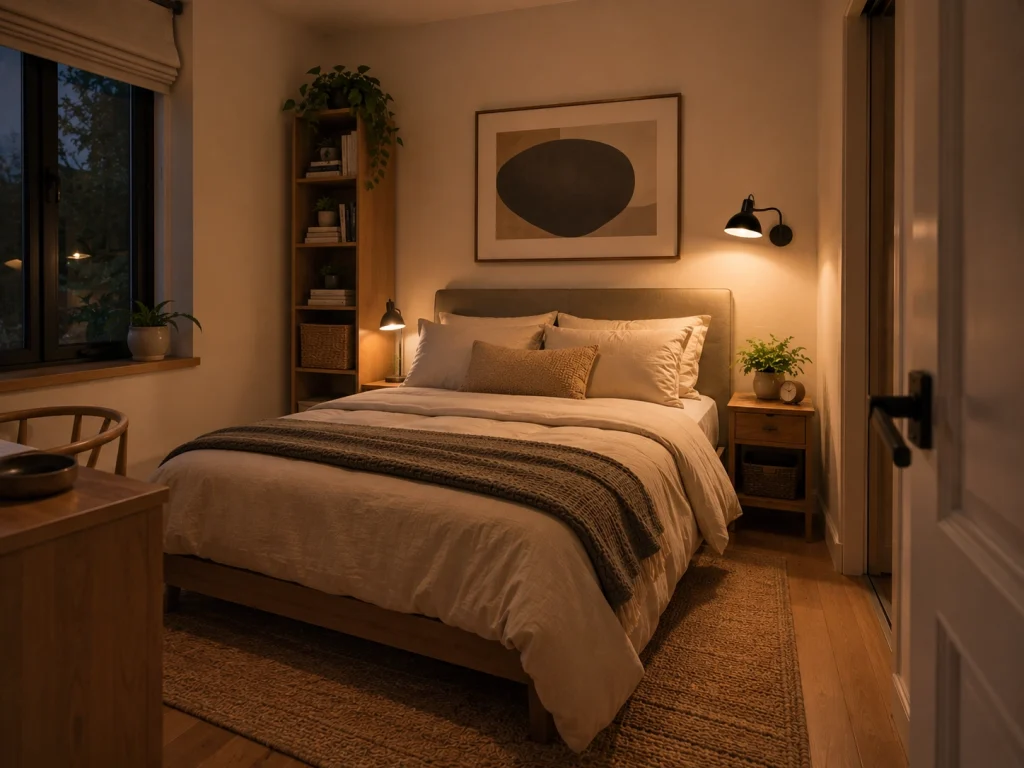
How to Arrange Furniture in a Small Bedroom
A good small-bedroom layout is easier to create when you work in a fixed order instead of moving everything around at once.
Step 1: Place the bed first
Choose the position that gives the bed enough usable space while respecting doors, closets, windows, and other fixed features.
Do not start with the nightstands or dresser. The bed determines the rest of the layout.
Step 2: Protect the main walking path
Identify how you naturally enter and move through the room. Keep this route as direct as possible.
If a dresser or chair interrupts the path, move it before adding anything else.
Step 3: Add essential storage
Once the bed and walking path work, add the storage you genuinely need.
Prioritize pieces that fit the available width and depth. A smaller storage unit that is easy to access is often better than a larger one that makes the room difficult to move through.
Step 4: Use walls for secondary functions
If you still need shelving, lighting, artwork, or a compact workspace, look upward and along the walls before adding more floor furniture.
Vertical storage, wall lighting, and shelves can provide useful functions while preserving the floor.
Step 5: Add decoration last
Only after the practical layout works should you decide where artwork, plants, baskets, mirrors, and other decorative elements belong.
This order matters because decoration should support the room rather than determine its layout.
5 Small Bedroom Mistakes That Make a Room Feel Smaller
1. Furniture That’s Too Large
Oversized furniture consumes both floor space and visual attention.
Before buying a piece, measure its width and depth and compare those dimensions with the room’s available floor area. Pay particular attention to how much space remains around the bed and along the main walking route.
2. Poorly Planned Furniture Placement
A room can feel cramped even when every piece technically fits.
Furniture that blocks doors, interrupts walking paths, or creates awkward gaps makes the room harder to use. Solve the basic circulation pattern before worrying about styling.
3. Too Many Small Decorative Objects
A collection of tiny accessories can create more visual noise than one larger focal point.
Group small items, remove pieces that do not serve a purpose, and leave some surfaces partially empty.
4. A Rug That’s Too Small for the Furniture Arrangement
A rug that sits randomly between the bed and furniture can make the layout look fragmented.
Choose the rug according to the area you want it to define, then check that its placement works with the bed, nightstands, doors, and walking paths.
5. Ignoring Vertical Space
When floor space disappears quickly, adding more low furniture is usually not the only answer.
Use wall height for storage, lighting, shelves, or artwork. Just keep the upper areas organized so vertical storage does not become another source of visual clutter.
What Actually Makes a Small Bedroom Feel Bigger?
There is no single decorating trick that makes a small bedroom work. The strongest results usually come from several modest decisions reinforcing each other.
Scale: Furniture should fit the room and leave enough usable floor space.
Layout: The bed, storage, and major furniture should create a clear route through the room.
Storage: Belongings should have places that do not overwhelm visible surfaces or walking areas.
Visual continuity: Related colors, materials, and shapes can help the room feel connected rather than fragmented.
Restraint: Empty wall and floor space are useful design elements. Not every gap needs to be filled.
The goal is not to disguise the bedroom’s actual size. It is to make the available space feel deliberate and easy to use.
Frequently Asked Questions
What colors make a small bedroom feel bigger?
Lighter colors can help create a bright, continuous appearance, but a small bedroom does not have to be white. Soft neutrals, muted colors, and even deeper tones can work when the palette is cohesive. Consider the room’s natural light, furniture, and textiles together rather than choosing a wall color in isolation.
How can I make a small bedroom feel less cramped?
Start with the layout before adding decor. Place the bed carefully, protect the main walking path, reduce oversized furniture, and remove objects that do not need to remain visible. Then use lighting, mirrors, and a restrained color palette to support the feeling of openness.
Where should I put my bed in a small bedroom?
Start with the wall that allows the bed to fit while preserving the most useful walking and storage space. Centering the bed can create a balanced arrangement, but it is not always the best choice. Doors, closets, windows, and circulation should determine the final position.
How can I add storage without making a small bedroom feel crowded?
Use storage according to the space you actually have. Tall shelving, under-bed storage, narrow furniture, and appropriately sized wall-mounted solutions can help preserve floor space. Keep frequently used items accessible and store less frequently used belongings higher up or underneath the bed.
Is dark paint a bad idea for a small bedroom?
Not necessarily. Dark or mid-tone colors can create a more enveloping atmosphere when used intentionally. The important considerations are the room’s natural light, the other colors and finishes in the space, and whether you want the walls to feel visually quiet or more dramatic.
Final Thoughts
A small bedroom does not need to be tricked into looking like a large one.
The better goal is to make every part of the room feel intentional. Good scale keeps furniture from overwhelming the space. A practical layout protects movement. Thoughtful storage reduces visible clutter. A controlled color and material palette keeps the room visually calm.
Once those fundamentals are working, decoration becomes much easier.
You may find that the room does not need another shelf, another basket, or another decorative object at all. Sometimes the most effective small-bedroom improvement is simply giving the things you already own more room to breathe.
1 comment